

Company advantages
Advanced Equipment
The quality of equipment is strictly in accordance with ISO9001 standard and with CE certificate, electrical meets UL certificate.
Professional Team
CEO holds a graduate degree in mechatronics and is dedicated to research in mechanical design, PLC applications, and microcontrollers. His scientific work involves the design of production lines and automation programs for mechanical equipment, and he has obtained multiple patents.
Rich Experience
We have been in this field for more than 15 years. I am very familiar with raw material processing and production processes and technologies.
Our Services
Provide clients one-year warranty to make sure the machine work well.Act as a good adviser and assistant of clients to enable them get rich and generous returns on their investments.
Vacuum drying is a mass transfer operation in which moisture present in a substance (usually a wet solid) is removed by creating a vacuum. In chemical processing industries such as food processing, pharmacology, agriculture and textiles, drying is a fundamental operation for removing moisture. Vacuum drying is often used to dry materials that are sensitive to hygroscopicity and heat. The principle is to create a vacuum to reduce the chamber pressure below the vapor pressure of water, causing it to boil. With the help of a vacuum pump, the pressure around the material to be dried is reduced.





Benefits of Vacuum Dryer
Reduced cycle time
Achieving a higher “U” factor to our Mechanical Fluidized Action complimented by the dryer's chopper/mills reduces the cycle times.
01
Particle size control
High-speed chopper/mills control the size of the particles and by utilizing the energy input the units provide the same particle size distribution batch after batch.
02
Better temperature control
The dryer has a superior jacket design to control the heating media flow and eliminate hot or cold spots which combine with the Mechanical Fluidized Action to control the product temperature.
03
Multi-step operations
Reaction, mixture, liquid dispersion, and granulation are just a few of the dryer's capabilities.
04
Moisture control
The Mechanical Fluidized Action and the particle size control of these dryers allow for manufacturers to receive the same percentage of moisture or solvent levels batch after batch.
05
Pharmaceutical Industry
Vacuum drying machines are extensively used in the pharmaceutical industry to dry heat-sensitive materials, such as powders, granules, and pharmaceutical intermediates. It helps preserve the quality, stability, and efficacy of the final drug products.
Food Industry
Vacuum drying machines are employed to remove moisture from food products, such as fruits, vegetables, herbs, and spices. This helps extend their shelf life by preventing spoilage, mold growth, and degradation of flavor, color, and nutritional value.
Chemical Industry
Vacuum drying machines find application in the chemical industry for drying various chemical compounds, catalysts, polymers, and intermediates. Vacuum drying prevents oxidation, degradation, or decomposition of sensitive chemicals during the drying process.
Biotechnology and Life Sciences
Vacuum drying is commonly used in the biotechnology and life sciences field for drying biological samples, freeze-dried vaccines, enzymes, DNA, and other lab-scale or production-scale biopharmaceutical products.
Electronics Industry
Vacuum drying machines are utilized in the electronics industry for drying sensitive electronic components, circuit boards, or devices that require low moisture content to prevent damage or malfunction caused by moisture.
Materials Science and Research
Vacuum drying machines are used in research laboratories and materials science applications for drying sensitive materials, such as powders, ceramics, composites, and films, under controlled conditions.
Types of Vacuum Dryer
Tumble vacuum dryers
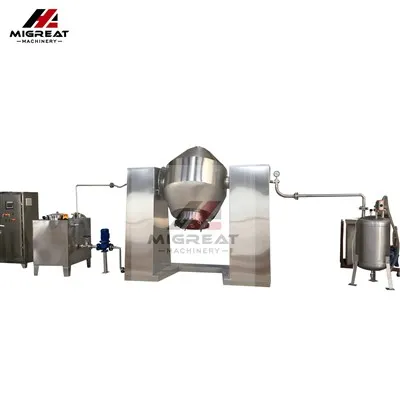
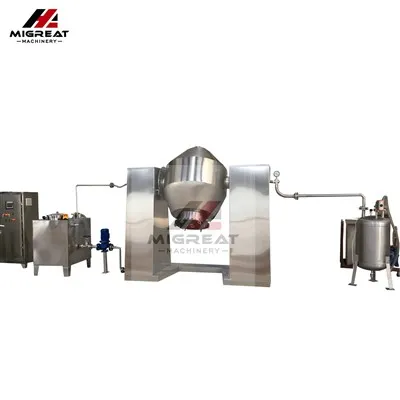
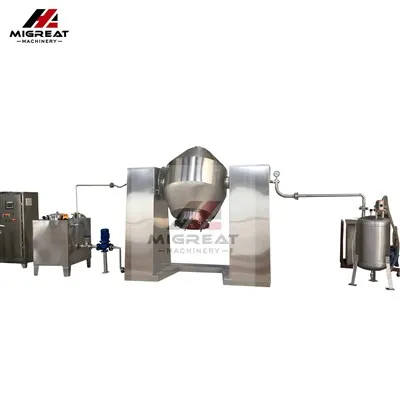
The tumble vacuum dryer consists of a rotating or tumbling vessel, most commonly in a double-cone shape. By controlling atmospheric pressure, the vacuum dryer increases the effective ΔT for a given process.A thermal jacket encloses the entire vessel; the vessel is supported by two trunnions. A small, stationary vacuum line in one trunnion extends into the vessel; a small vacuum filter is located at the line's inlet. A delumping bar can be mounted on one trunnion and extend into the drying chamber.In operation, the vessel rotates about the trunnions' axis. The integrity of the seal around the stationary vacuum line - which extends through the trunnion and is angled upward into the drying chamber's top, above the material in the rotating vessel - is critical for maintaining the dryer's vacuum. During rotation, the material cascades inside the chamber, gently tumbling and folding to bring the material into contact with the heated walls. This action makes the dryer especially suitable for handling friable and fragile materials that can't withstand shear from agitation, such as polyethylene terephthalate pellets. The delumping bar can be operated intermittently to break up undesired agglomerates.
Agitated vacuum dryer
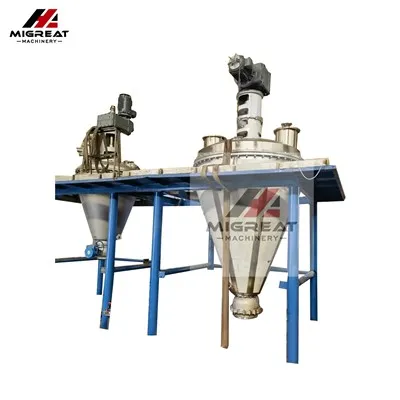
The agitated vacuum dryer consists of a stationary cylindrical or trough-shaped vessel that has a rotating shaft mounted with agitators of various configurations. The dryer can handle wetter materials and less free-flowing materials than the tumble dryer.The dryer's agitator configurations are based on various blender designs, including ribbon, paddle, and plow mixers. In some models, the rotating shaft and agitators can also be heated with hot media. A large vacuum line is connected to a large jacketed vacuum filter housing at he dryer vessel's top.Your material's particle characteristics at different moisture levels can vary in unexpected ways.In operation, the material is blended as the shaft-mounted agitators rotate and move the material into contact with the dryer's heated walls (and, in some cases, the heated shaft and agitators). The agitation permits the dryer to handle materials approaching slurry consistency or sticky materials with high viscosity. Examples include various clays, aluminum pastes, and other metal pastes.
Drum
The main component of the dryer that rotates and holds the materials to be dried.
Drive assembly
The mechanism that drives the rotation of the drum.
Vacuum system
The system that creates the vacuum conditions within the dryer, including the vacuum pump and associated piping.
Heating system
The system that provides heat to the materials being dried, such as a hot oil jacket or steam coil.
Agitator
A component that is sometimes used to improve the mixing and drying of the materials within the drum.
Discharge mechanism
The mechanism that allows the dried materials to be removed from the dryer, such as a valve or screw conveyor.
Control system
The electronic or mechanical system that regulates the temperature, pressure, and other parameters of the drying process.
Insulation
The layer of material that is used to prevent heat loss and maintain the temperature inside the drum.
Condenser
The component that is used to condense any vapor that is produced during the drying process, which helps to maintain the vacuum conditions within the dryer.
Seals
The seals that are used to prevent air from entering the dryer and disrupting the vacuum conditions.
How to Choose Vacuum Dryer
Sample volume
Consider the quantity of materials you need to dry in a single batch. If you have large samples or need to dry a significant volume of materials simultaneously, you will require a larger oven.
Available space
Evaluate the space you have in your laboratory or work area. Make sure the vacuum drying oven you choose fits comfortably in the available space without obstructing other equipment or workstations.
Sample size and shape
The size and shape of your samples will also play a role in selecting the appropriate oven size. Ensure that the oven's chamber dimensions can accommodate your largest samples without crowding.
Throughput and efficiency
If you have a high volume of samples that need frequent drying, you might consider a larger oven with faster processing capabilities to improve efficiency.
Future needs
Think about potential changes in your workload or expansion of your research. Selecting a vacuum drying oven with some extra capacity may be beneficial if you anticipate an increase in the volume of materials you'll need to dry in the future.
Budget
Vacuum Dryer ovens typically come with higher costs. Evaluate your budget and balance it with your requirements to find the most suitable size for your needs.
The working principle behind the operation of a Vacuum Dryer involves substantially lowering the ambient pressure to decrease the boiling point of the liquid in the substance via the use of a vacuum pump. A considerable reduction in boiling point increases the rate of evaporation of the liquid and hence fastens the drying rate of the substance. Moreover, lowering the boiling point indicates that operating temperatures could be much lower as compared to regular air oven. Hence, heat sensitive substances could be dried with minimal effect to their physical or chemical properties. Additionally, lack of air (or oxygen) during the drying process significantly reduces the chances of substance oxidation.
How to Maintain Vacuum Dryer
Regular cleaning
Regular cleaning is one of the important steps in maintaining a vacuum dryer. During use, the device.dust and debris may accumulate on the surface and inside, affecting the normal operation of the equipment. Therefore, it is determined that regular cleaning is necessary. Firstly, power off the device and confirm that it is in a safe state,use a clean cloth or brush to remove dust and debris from the surface of the equipment. Then, use a vacuum cleaner or clean the interior of the equipment with compressed air to ensure that dust does not affect the operation of the equipment. Clean after completion, check if all parts of the equipment are clean. If necessary, they can be cleaned again to ensure ensure the cleanliness of the equipment.
Lubrication maintenance
Lubrication maintenance is one of the key links in the maintenance of vacuum dryers. Proper lubrication can reduce equipment wear and tear can improve equipment operational efficiency. Firstly, it is necessary to regularly check the lubrication of the equipment,ensure sufficient lubrication of the components. Secondly, choose appropriate lubricants for lubrication and pay attention to their use the type and quality of lubricants. Regularly add or update according to equipment usage and manufacturer recommendations change the lubricant to ensure smooth and stable operation of the equipment. Finally, promptly remove excess moisture lubricants, to avoid waste of lubricants and negative impacts on equipment.
Electrical inspection
The electrical system of a vacuum dryer is an important component of its normal operation. Regular check of electricity the connection of the gas system and the electrical performance of the equipment are necessary. Firstly, check the electrical wiring check for any issues such as breakage or looseness to ensure good circuit connections. Secondly, check the electrical equipment whether the working status and parameters of the backup are normal, such as temperature sensors, temperature controllers, etc. If discover abnormal situations and promptly repair and replace them. Finally, check the grounding condition of the equipment, ensure the safety and reliability of the equipment.
Replacement of spare parts
Regularly replace some vulnerable parts and critical components based on the service life and actual operating conditions of the equipment.components to extend the service life of the equipment. Common vulnerable parts include seals, rubber rings the normal condition of filters and other components directly affects the sealing and operational effectiveness of the equipment.regular replacement of these components can ensure the normal operation of the equipment and extend its service life. Replacing when selecting spare parts, it is necessary to choose original factory spare parts that meet the equipment requirements or substitute products with reliable quality to ensure the replacement spare parts are guaranteed to function properly.
Precautions for Each Operation Step of the Vacuum Dryer
Sample Placement
Put the material to be dried evenly on the sample rack in the vacuum drying oven box and push it into the drying box:
① Place the sample in the oven without the heating being turned on.② When placing the sample, a certain space should be reserved on the upper and lower sides to keep the airflow in the box smooth.③ If the sample changes phase during the drying process, it must be stored in a tray to avoid contamination of other samples.④ If the dry materials become lighter in weight and smaller in volume after drying, a barrier net should be placed on the vacuum port in the vacuum drying oven box to protect the vacuum pump (or solenoid valve) from damage caused by dry matter inhalation.
Close the Door of the Vacuum Drying Oven
Close the door of the Vacuum drying oven gently.Precautions:
① Do not use too much force when closing, to avoid causing the box of the vacuum drying oven to vibrate greatly.② There are bolts on the box door. Make sure the box door and the silicone sealing strip are properly joined before closing.
Switch the Vacuum of the Vacuum Drying Oven on
Connect the vacuum pump to the vacuum valve, turn on each component individually, then expel the vacuum. Precautions:
① The vacuum pump's limit value when the pressure gauge is pumped shall take precedence based on how well it performs.② After attaining the vacuum degree, close the vacuum valve (if the vacuum valve is not tightly closed, it must be replaced soon), and then turn off or unplug the vacuum pump (to prevent the phenomenon of sucking back). ③ Check the vacuum pressure gauge to make sure the reading is steady and devoid of noticeable fluctuations.④ If the vacuum degree is lower than the requirement of dry items, you should turn on the vacuum pump power and vacuum valve again, and continue to vacuum. It can increase the vacuum pump's useful life.
Heating
Set the desired temperature after turning on the heat.Precautions:
① The heating process must be performed in a stable vacuum state; otherwise, the difference in internal and external pressure and temperature will readily result, leading to unexpected events such as the outside air bursting into the box.② The heating indicator light will be on for a long time while the appliance is heating. When the temperature is reached, the heating will automatically stop and the indicator light will turn off. The heating cycle restarts and the heating indicator turns on when the temperature falls below the predetermined level.③ Normal display of the heating indication and temperature is required. If the indicator is not on, the power should be promptly cut off, and the instrument's owner should be informed.
Our Factory
Migreat machinery covers 10,000 square meters, factory area is 15,000 square meters with machining workshop, welding workshop, cold stamping workshop, assembly workshop and electrical workshop. The quality of equipment is strictly in accordance with ISO9001 standard and with CE certificate, electrical meets UL certificate.CEO holds a graduate degree in mechatronics and is dedicated to research in mechanical design, PLC applications, and microcontrollers. His scientific work involves the design of production lines and automation programs for mechanical equipment, and he has obtained multiple patents. Therefore, he has rich experience in the processing and production of raw materials such as powders, particles, tablets, liquids, etc., and can better design and provide more suitable solutions from the perspective of customers.
FAQ
As one of the most professional vacuum dryer manufacturers and suppliers in China, we're featured by quality products and competitive price. Please rest assured to buy cheap vacuum dryer made in China here from our factory. Contact us for customized service.
manual coating machine, wholesale grinding machine, coating machine for glass