 +86 139 1520 0887
 info@migreatmachinery.com
V blender vs ribbon blender is a choice between two ways of mixing. A V blender tumbles the batch in an off-center barrel and suits dry, fine or moist powder with a small additive. A ribbon blender turns spiral ribbons in a horizontal trough and suits large batches, powder with liquid and paste. The 3D mixer is a third route, with a barrel that swings, moves and rolls at once.
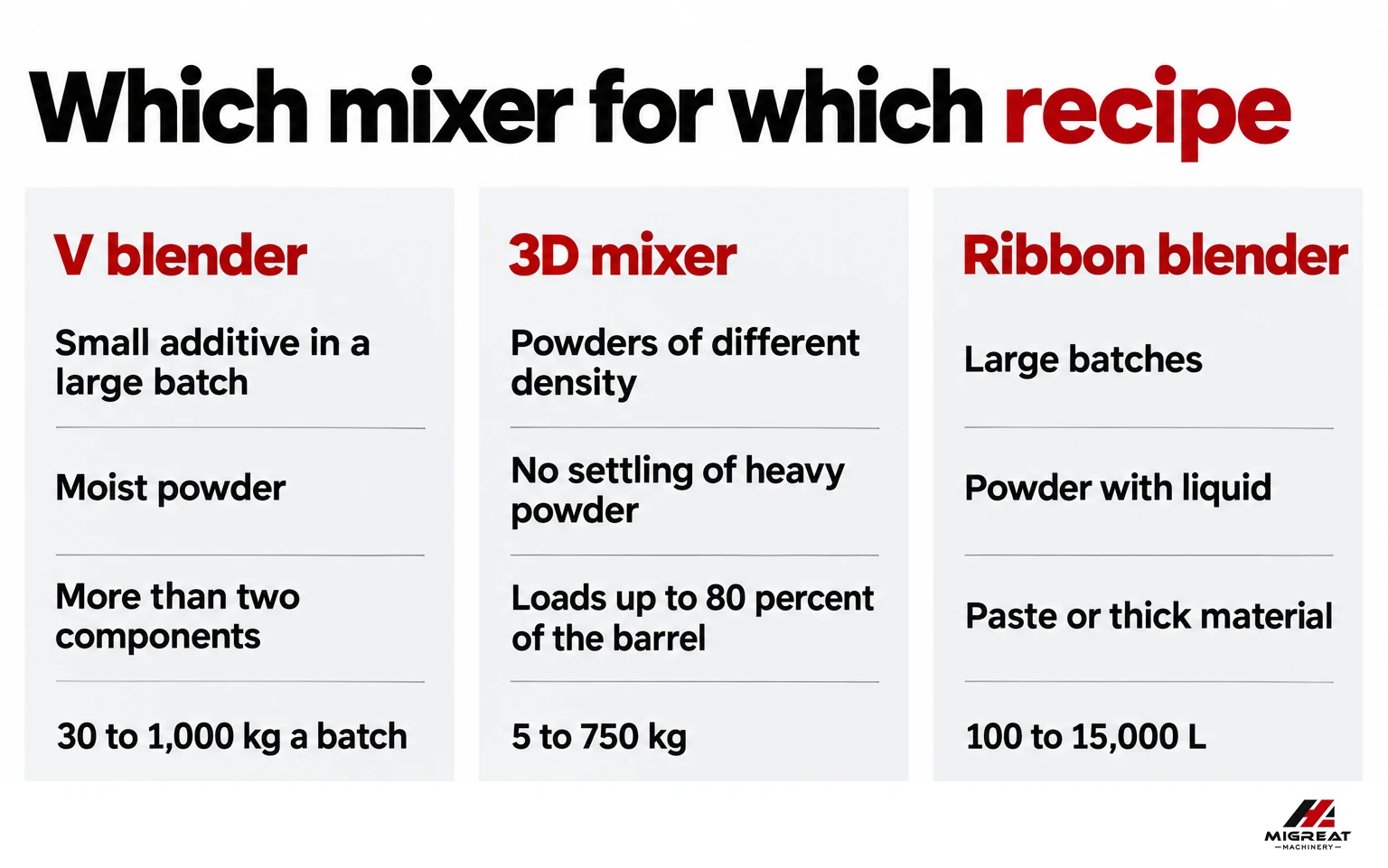
Pick by the recipe first, then the batch size, then cleaning and discharge. The three Migreat families cover different ranges. V blenders run from 100 to 2,000 L, 3D mixers from 10 to 1,500 L and ribbon blenders from 100 to 15,000 L.
- V blender, 3 to 15 minutes a batch, 30 to 1,000 kg, a small additive blends in well
- 3D mixer, 0 to 30 rpm, loads up to 80 percent of the barrel, powders of different density do not settle
- Ribbon blender, load coefficient 0.4 to 0.8, powder with powder, with liquid or with paste
- Check the batch size, the fill level and the cleaning before the price
Searching for V blender vs ribbon blender returns a lot of pages that rank them on a single point, usually price or size. A mixer is not chosen on one point. It is chosen on how the recipe behaves, and the same powder can blend well in one machine and badly in the next.
This page sets the V blender, the 3D mixer and the ribbon blender side by side, using the figures on the Migreat machine pages. It explains the two families of motion, reads the batch tables, works through an example and lists what to ask before you order. It does not rank the machines, because the right one depends on your powder, and it does not cover paddle or plough mixers, which have their own comparison.
V blender vs ribbon blender vs 3D mixer in one table
The table sets the three families on the points that usually decide a purchase. Each cell is taken from the machine page, and where a page does not state a figure the cell says so.
The pattern is easy to see. The tumble machines are the choice for gentle blending of dry material at small and medium batch sizes, and the ribbon blender is the choice for large batches and for recipes with a liquid. The overlap is in the middle, between about 500 and 1,500 liters, where several machines can do the job and the details of the recipe decide.
Ribbon blender uses and where it stops
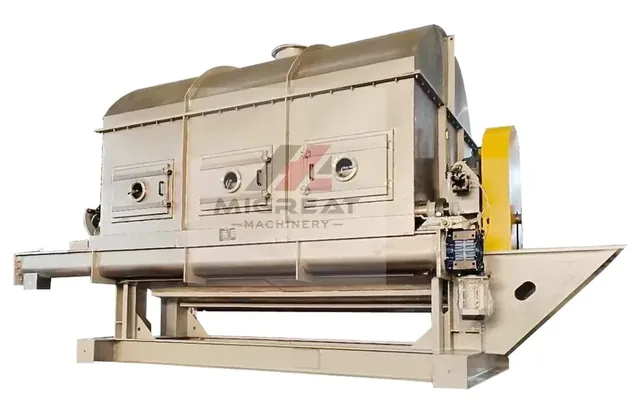
If you are asking what is a ribbon mixer for, or what is a ribbon blender, the short answer is a plant that mixes large dry batches, or batches with a liquid. The WLDH page lists milk powder, coffee powder and protein powder, spice, flavor and seasoning, supplement powder and additives, and putty powder, gypsum, pigment and dyes. Those ribbon blender uses cover food, chemical and building materials with the same machine type.
It stops where the batch is small or the product changes often. A ribbon blender holds a lot of powder in a trough with a shaft, so a 50 kg batch in a 1,000 L machine mixes badly and cleans slowly. It also stops where the powders differ so much in density that the ribbons cannot hold them together, and where a very gentle action is needed. For those cases a tumble blender is the better start.
Where each one is used
The pages name the industries for each family. The V blender page says pharmacy and related industries, and the machine meets GMP. The 3D mixer page says pharmacy, chemical and food, for powders of different granule size and gravity. The ribbon page covers food and pharmacy as well as chemical and building materials such as putty powder, gypsum and pigment.
That split follows size and cost more than it follows the product. Pharmacy and laboratory work runs small batches with tight cleaning rules, which suits the V and 3D machines. Food and chemical plants run large batches, which suits the ribbon blender. A plant that does both usually owns both, and the mixing machines page shows the other options in between.
Two families, tumbling and agitating
The V blender vs ribbon blender question is really a question about these two families. The V blender and the 3D mixer are tumble blenders. The vessel moves and the powder falls through itself, with no part inside pushing it. The ribbon blender is an agitator mixer. The trough stands still and a shaft with ribbons moves the powder. The two families fail in different ways, and that is the best way to choose between them.
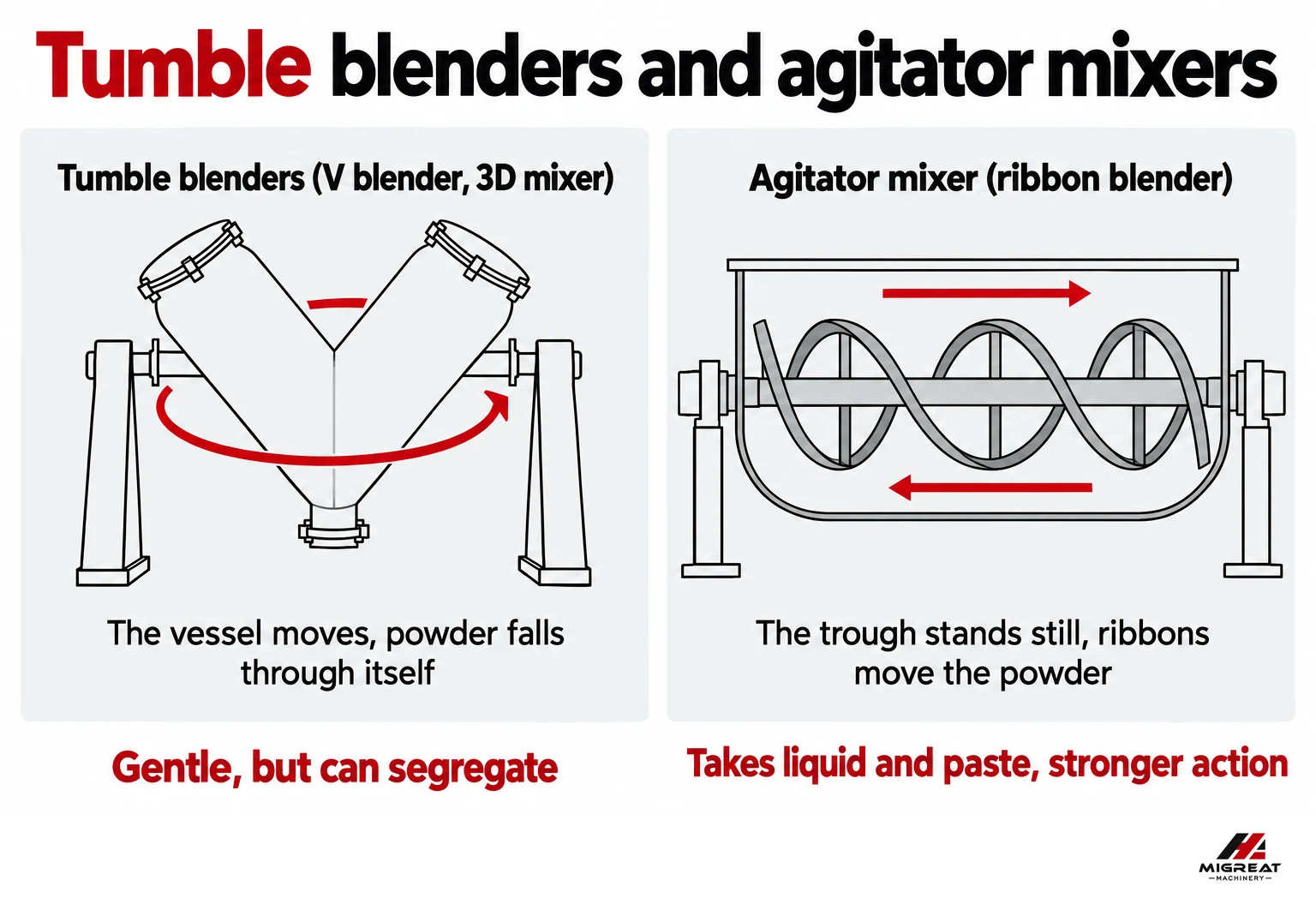
A tumble blender is gentle. Nothing inside cuts or crushes the particles, so fragile granules survive. Its weakness is that a tumbling batch can segregate if the powders differ much in density or size, and that a sticky or damp powder can cake on the wall. An agitator mixer forces the powder to move, and it can handle damp and sticky feeds and add liquid. Its weakness is a small dead zone near the discharge and the shaft, and a stronger action on the particles.
How does a V blender work
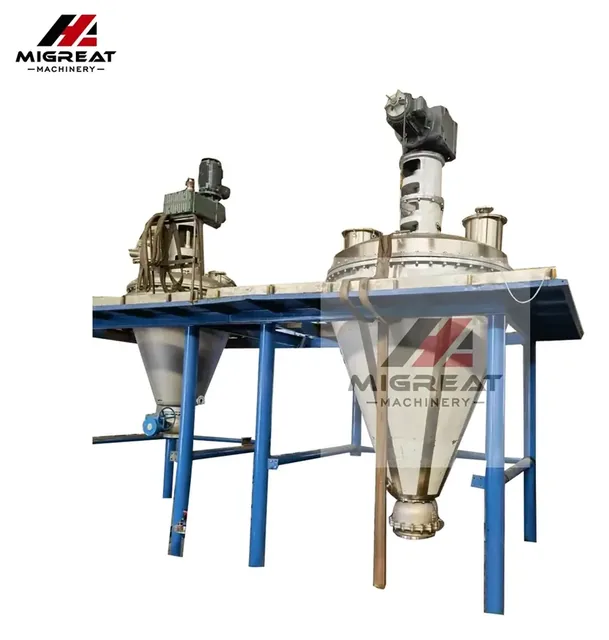
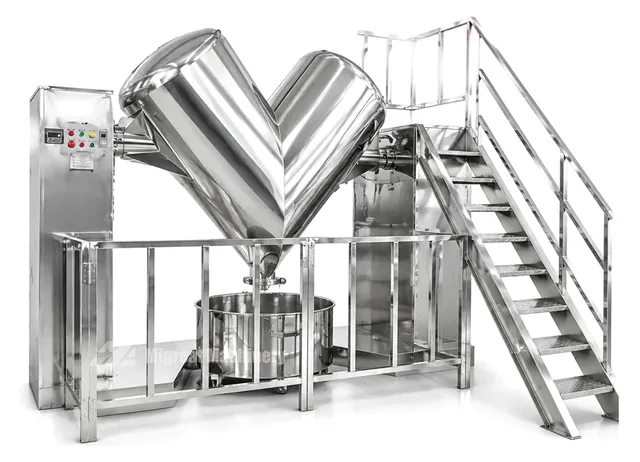
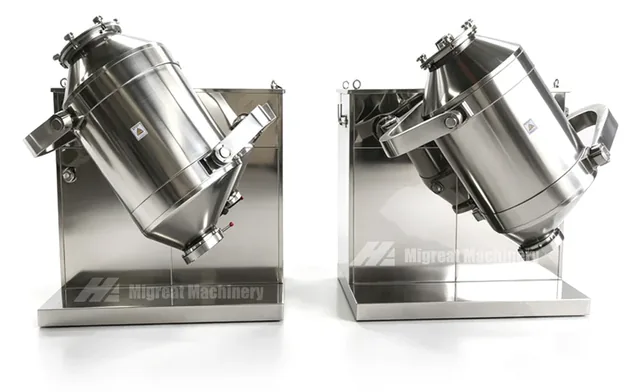
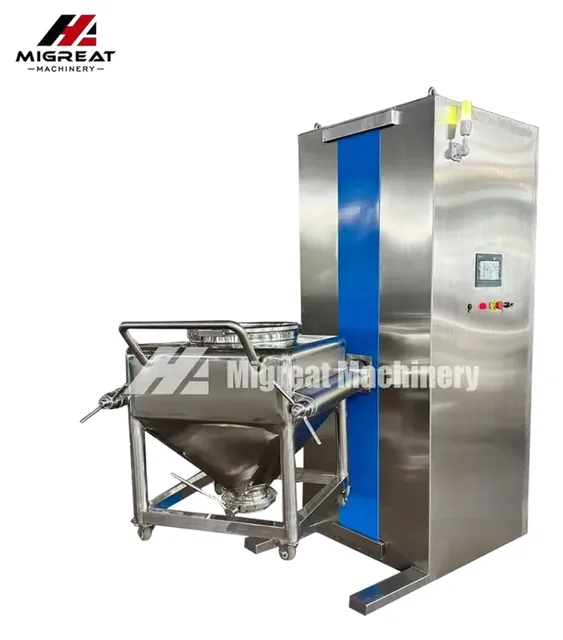
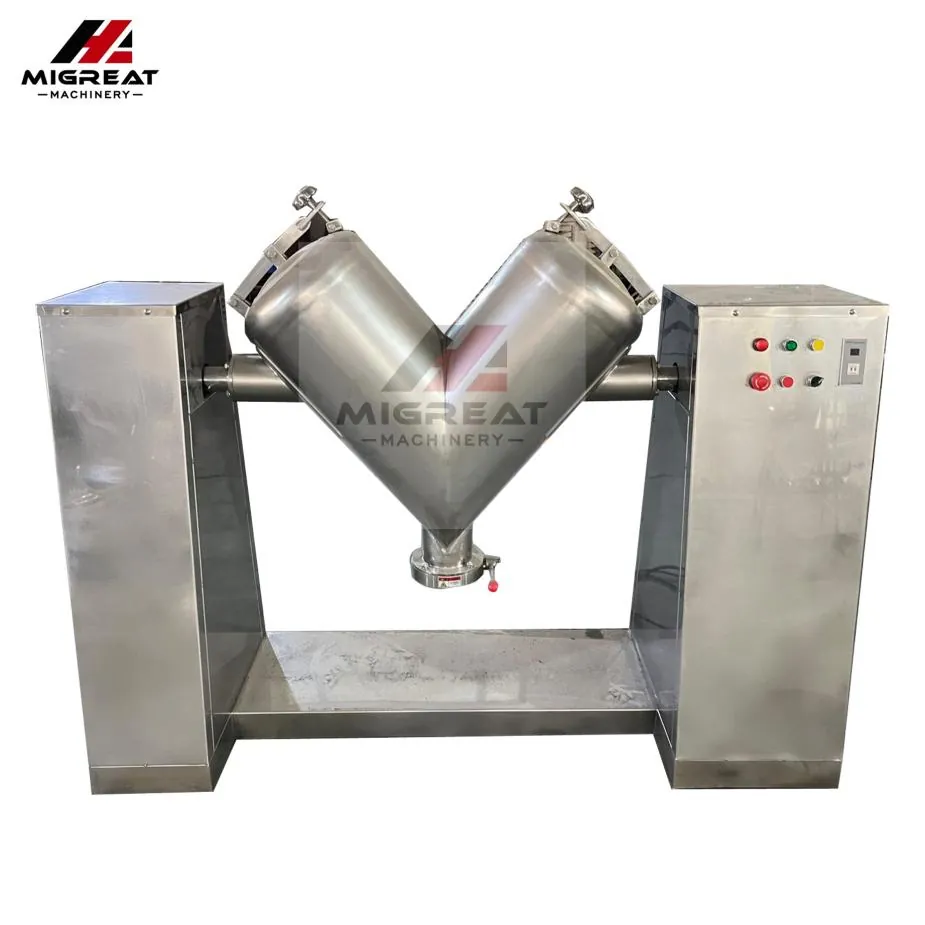
The V blender has an off-center barrel, also called an unbalanced barrel. As it turns, the material splits into the two arms of the V and then recombines at the bottom. The page says it mixes thoroughly in 3 to 15 minutes. You load the powder, close the lid, run the batch and release it through a butterfly valve at the bottom.
The page names three strengths. It mixes fine powder, more than two kinds of powder and material that contains water. It gives a good result with a small quantity of additive. The inside is smooth stainless steel with no dead angle, and the page states that the mixer meets GMP and carries CE certification. Options include a stir bar, a spray system for liquid, vacuum and a frequency changer for speed.
What is a 3D blender and how does the 3D mixer work
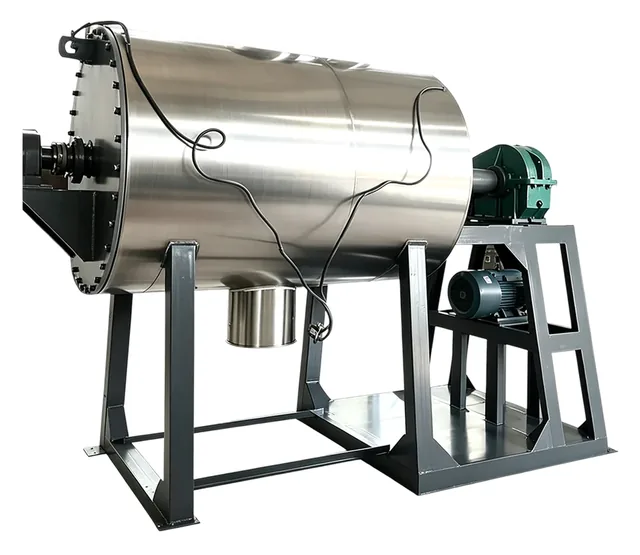
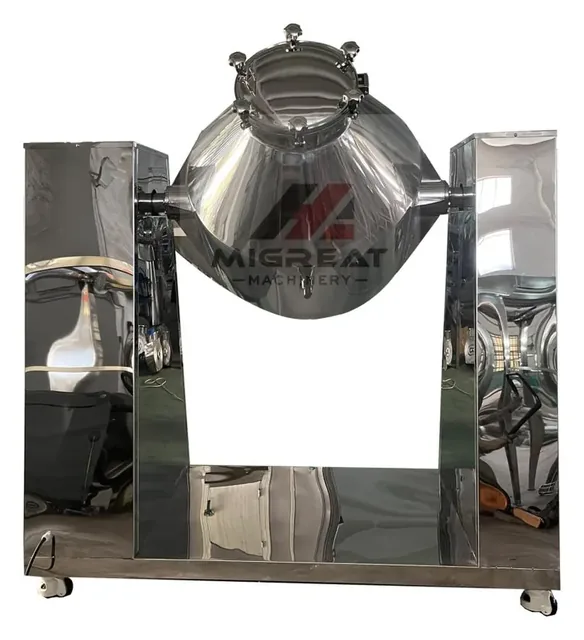
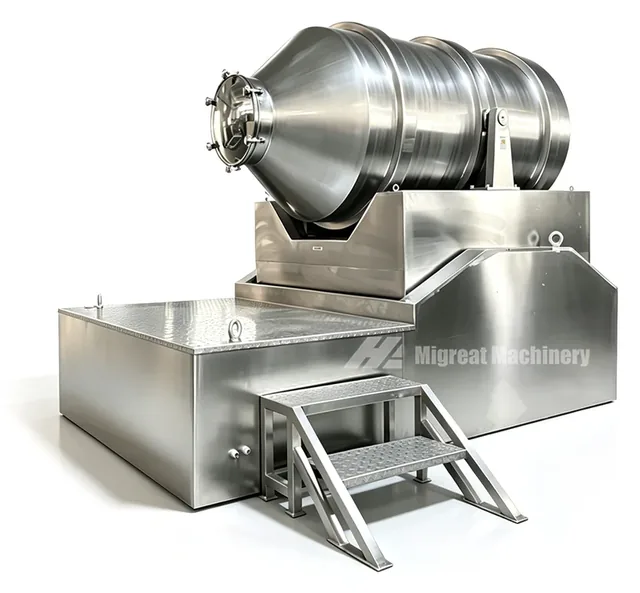
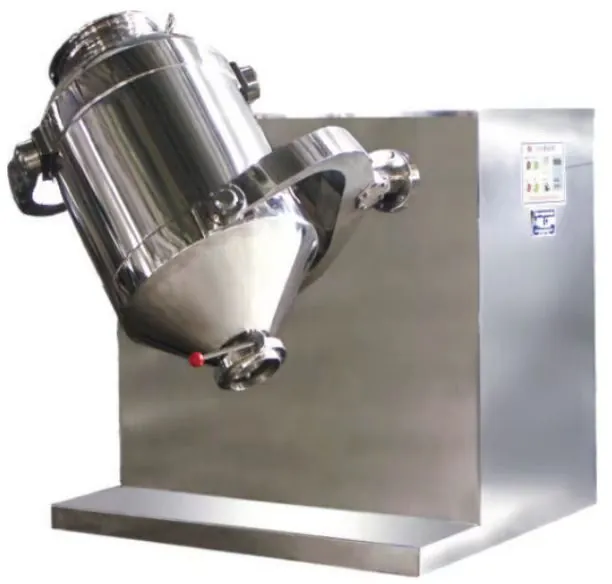
On the SYH 3D mixer the cylinder swings, moves in parallel and rolls at the same time, driven by the main axis. A strong pulse movement pushes the material forward in circular, radial and axial directions, and a changeable vortex mixes different materials evenly. The page says that this motion mixes powders of different density without letting the heavy ones settle at the bottom.
Three more facts matter. The maximum loading is 80 percent of the barrel volume, which is high for a tumble blender. The speed is variable from 0 to 30 rpm through an inverter. And the cylinder and frame sealing plate are SUS304. The range runs from 10 L, which is a laboratory or pilot size, to 1,500 L with 750 kg maximum loading.
How the ribbon blender works
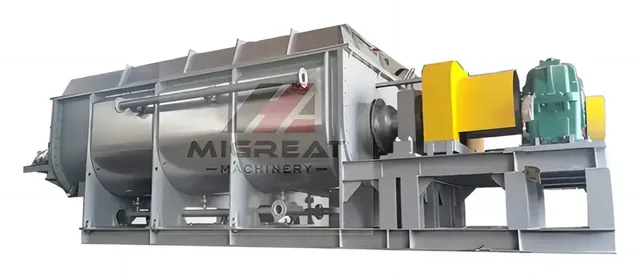
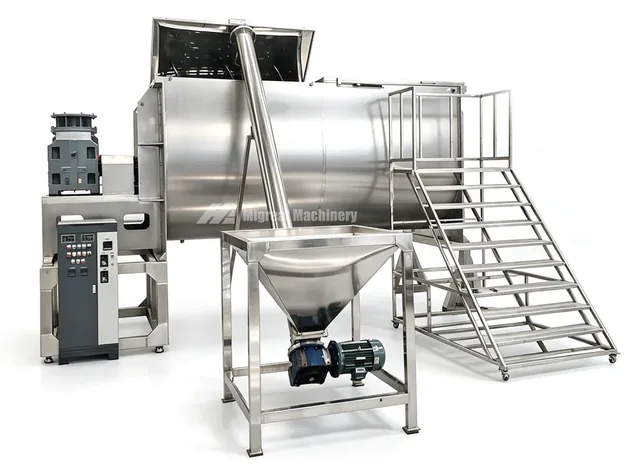
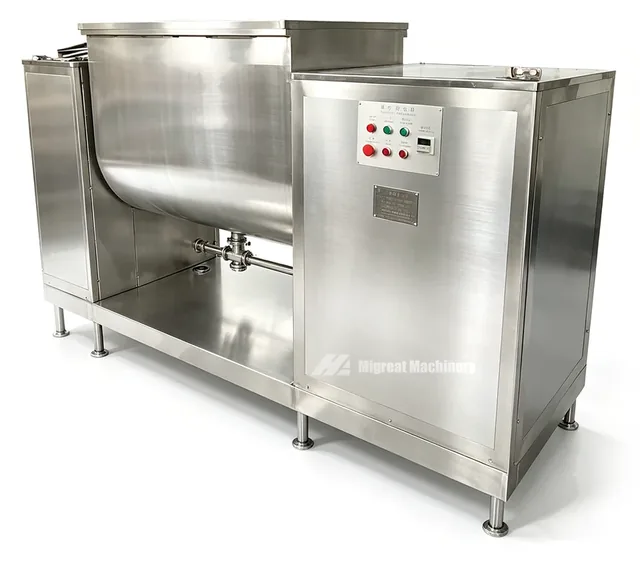
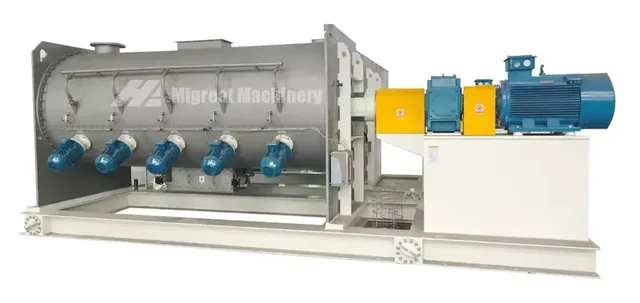
A motor and reducer turn the main shaft, and the spiral ribbons on it move the material in two directions in the U shaped trough. The outer ribbon pushes it one way and the inner ribbon pushes it the other, so the batch circulates until it is even. A manual or pneumatic butterfly valve releases the batch. The page states high homogeneity with little damage to fragile material.
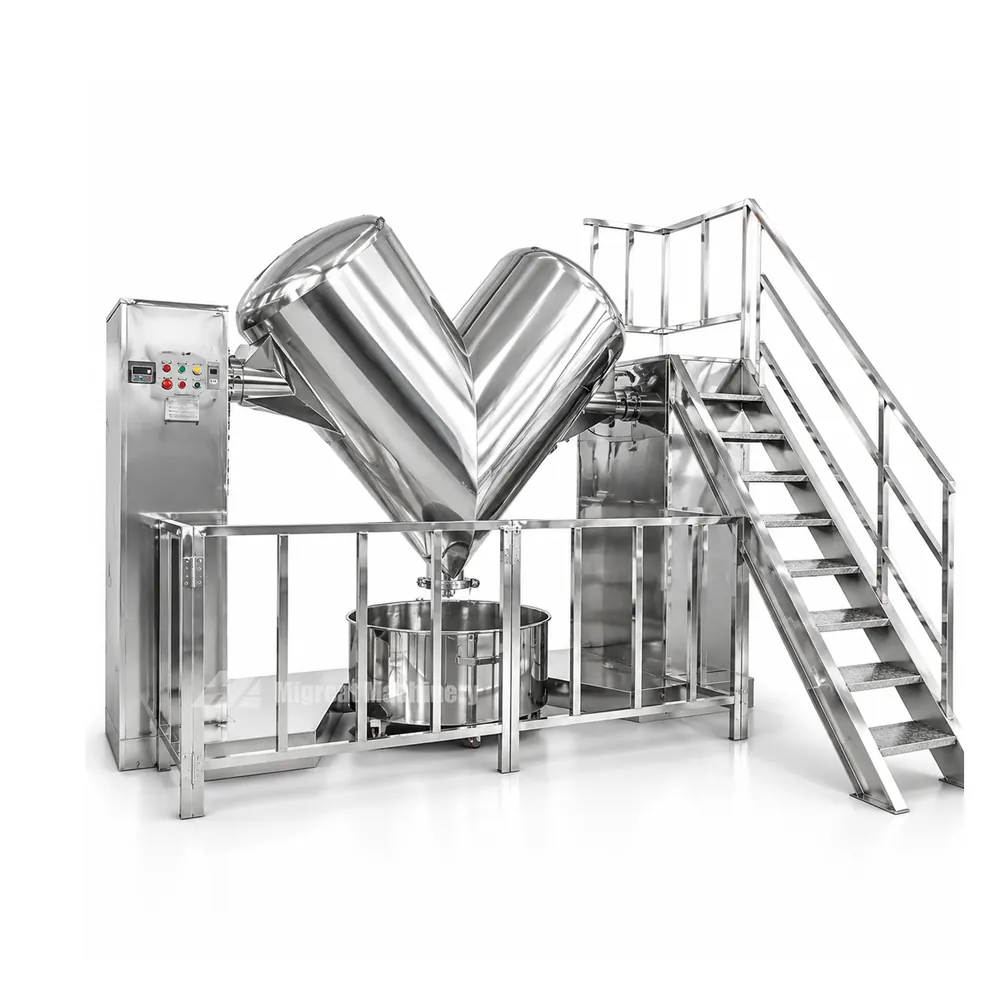
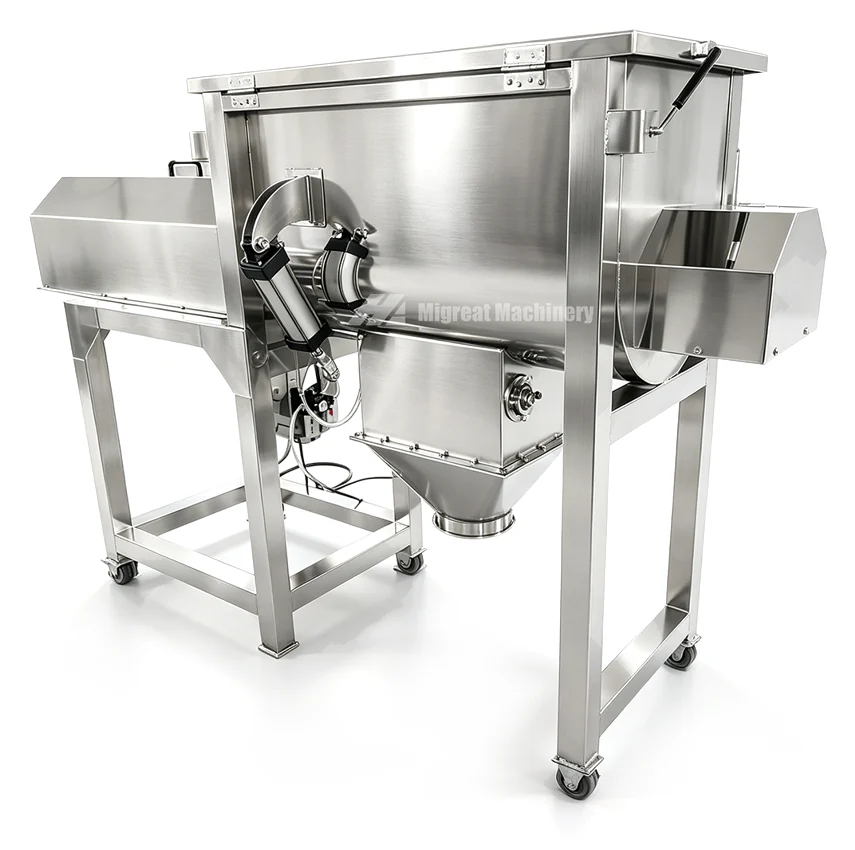
The ribbon blender is the only one of the three that the page rates for powder with liquid and for paste or thick material. It also goes to the largest sizes, 15,000 L with 75 kW, and it can sit on a platform with a control cabinet beside it. The ribbon blender working principle page goes through the mechanism in detail.
Batch size and fill level
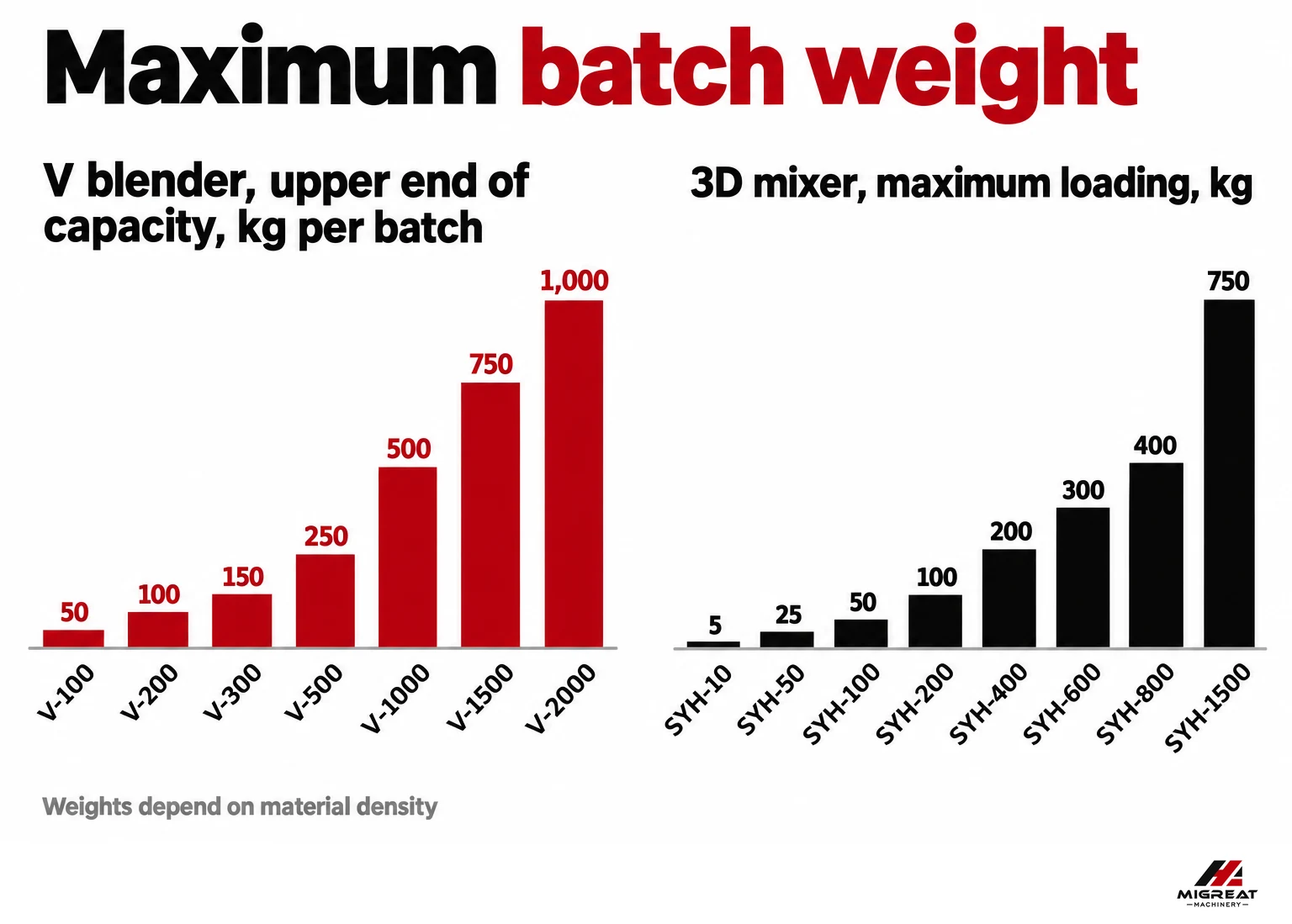
The fill level is where tumble blenders and ribbon blenders differ most. A tumble blender needs empty space above the powder, so that the batch can fall through itself. The 3D mixer allows 80 percent of the barrel. The V blender page gives a weight and not a fill level. A 100 L V barrel holds 30 to 50 kg, which at a bulk density of 0.5 is 60 to 100 L, so the fill the page assumes depends on a density it does not state. Always check the density you actually have, and ask the supplier which fill they assume.
The ribbon column is in liters, because the pages give a load coefficient and not a weight. Convert with your own bulk density. The table also shows the range gaps. The 3D mixer stops at 1,500 L and the V blender at 2,000 L, so batches beyond that point to a ribbon blender or to a double cone, which goes to 4,000 L.
Mixing time and uniformity
The V blender page states 3 to 15 minutes. The 3D page states short mixing time without a number. The ribbon page gives none. The honest reading is that mixing time depends on the recipe, and the only reliable way to set it is a trial that measures uniformity at several times.
A simple test takes samples from several places in the batch at set times and compares a marker ingredient, such as salt or a dye, across them. The time at which the samples stop changing is the minimum mixing time, and running past it wastes energy and can cause segregation in a tumble blender. Write the test into the specification, with the sampling points and the allowed spread, so that both sides measure the same thing.
Density, particle size and segregation
Segregation is when a blended powder separates again, usually because particles differ in size or density. Heavy and large particles move to the bottom or the edge. The 3D mixer page addresses it directly and says the motion avoids high density powder settling at the bottom. The V blender and ribbon blender pages do not make that claim, and both can segregate a poorly matched recipe during discharge or handling afterward.
The practical rules are general. Match the particle sizes where you can, add liquid binder or oil in small amounts if the recipe allows, keep the time between mixing and packing short, and avoid long drops and conveyors that shake the powder. A mixer cannot fix a recipe in which the components want to separate, and no machine page promises otherwise.
Moist powder, liquid and paste
The V page says it mixes material that contains water, and a spray system option can add liquid. The ribbon page rates powder with liquid and paste or thick material. The 3D page does not mention moisture. A recipe with liquid, oil or a sticky component should be tested on the machine it is bought for, because small changes in moisture decide whether the powder flows or cakes.
For wet or sticky feeds the ribbon blender, or a plough or tank mixer, is usually the safer start. The ribbon, paddle and plough comparison goes into the liquid options and the choppers that break lumps.
Cleaning, discharge and residue
Residue is what stays in the machine after discharge, and it matters whenever the product changes. The V page states a smooth inside with no dead angle and a butterfly valve at the bottom. The 3D page gives a SUS304 discharge valve. The ribbon page gives a manual or pneumatic butterfly valve and platform access. A round or conical vessel is easier to clean than a trough with a shaft and ribbons, and a washdown needs drains and a drying step.
Ask how the machine is cleaned, how long it takes, and what is left. For allergen changes or color changes the answer is the most important in the quotation. The double cone against V blender page covers the residue point for tumble machines.
A worked example, a seasoning blend
This is how the V blender vs ribbon blender choice looks on a real recipe. A seasoning plant mixes salt, sugar, spice powder and 1 percent of a flavor additive in batches of about 400 kg, and runs several recipes a week. The recipe has a small additive and powders of different density, the batch is mid sized and the cleaning between recipes matters.
The V blender is the first candidate, because the page names the small additive and the V-1000 holds 300 to 500 kg with 4 kW. The 3D mixer is the second, because salt is much denser than spice powder and the SYH-800 loads 400 kg at 7.5 kW. The ribbon blender is the third, and the WLDH-1000 would work at 400 to 800 L, but at 400 kg of seasoning with a bulk density near 0.8 it would run near the bottom of its range, and a ribbon blender runs best when it is well filled.
On these numbers the V blender wins on power and cost, and the 3D mixer wins on segregation risk. The plant should run its own recipe in both and compare the sample spread after the packing line, not just after the mixer.
Running cost and floor space
Power per batch is small for all three, and the difference is mostly in floor space and handling. A tumble blender needs head room and a platform for loading, and a ribbon blender is long and low. The V-1000 is 2.6 by 1.2 by 2.45 meters, the SYH-800 2.8 by 2.2 by 2.25 meters and the WLDH-1000 2.9 by 1.0 by 1.8 meters. Check the room, the loading height and the way the batch leaves the machine.
Loading and discharging are labor and dust. The V page mentions that it works well with vacuum charging equipment, and the pages for the others offer similar options. A vacuum loader from the conveying range takes the dust out of the loading step.
Mistakes buyers make when comparing a V blender vs ribbon blender
- Choosing on barrel volume and forgetting the weight a batch makes at your bulk density.
- Overfilling a tumble blender, which stops the powder falling through itself and lengthens mixing.
- Underfilling a ribbon blender, which mixes badly and wastes power.
- Judging uniformity at the mixer outlet and not after conveying and packing.
- Skipping the trial with the real recipe and the real additive.
What to ask in the quotation
- The batch weight at your bulk density, and the fill level the supplier assumes.
- The mixing time at which the sample spread meets your limit, measured on your recipe.
- The contact materials, the valve type and the cleaning access.
- Options for liquid, vacuum loading and speed control, and what each adds to the price.
- A trial on your own material, with sampling points agreed beforehand.
Mixers at work
The videos show a V blender, a 3D mixer and a horizontal ribbon mixer in motion.


Choose the mixer that matches the recipe and the batch, and prove the spread with a sample test, not a datasheet.
Send the recipe, the batch size, the bulk density and the cleaning needs through the contact page, and an engineer can recommend a model. The V shape mixer, SYH 3D mixer and WLDH ribbon mixer pages list every model, and the mixing machines page shows the full range.
Mixer selection FAQ
QWhat are the three types of blenders in this comparison?
A V blender tumbles a dry batch in an off-center barrel, a 3D mixer swings, moves and rolls its barrel at once, and a ribbon blender turns inner and outer ribbons in a horizontal U trough. The first two are tumble blenders and the third is an agitator mixer.
QV blender vs ribbon blender, which is better?
Neither is better in general. A V blender suits dry, fine or moist powder and a small additive at 30 to 1,000 kg a batch. A ribbon blender suits large batches up to 15,000 L, powder with liquid and paste. Start from the recipe, then the batch size, then cleaning.
QWhat is a ribbon blender used for?
A ribbon blender mixes powder with powder, powder with liquid, and paste or thick material. The WLDH page lists milk, coffee and protein powder, spice and seasoning, supplement powder, putty powder, gypsum, pigment and dyes, with high homogeneity and little damage to fragile material.
QWhat does a 3D mixer do that a V blender does not?
The cylinder of a 3D mixer swings, moves in parallel and rolls together, which the page says mixes powders of different density without the heavy one settling. It loads up to 80 percent of the barrel and runs at 0 to 30 rpm with an inverter.
QWhich mixer suits large production batches?
A horizontal ribbon blender. The WLDH range goes from 100 to 15,000 L with a load coefficient of 0.4 to 0.8. The V blender stops at 2,000 L and the 3D mixer at 1,500 L, so batches beyond those sizes point to a ribbon blender or a double cone.
QHow long does a V blender take to mix a batch?
The page states 3 to 15 minutes for every model, with a blending speed of 10 to 12 rpm. The right time for your recipe is the point where samples from several places stop changing, so measure it in a trial and write it into the specification.
QDoes the mixer choice change the cleaning?
Yes. A V blender has a smooth inside with no dead angle and a butterfly valve at the bottom. A ribbon blender has a shaft and ribbons in a trough, so there is more to clean. Ask each supplier how long a washdown takes and what residue is left.