 +86 139 1520 0887
 info@migreatmachinery.com
Dry granulation presses powder between two rollers into a sheet, then crushes and sifts the sheet into granules. It uses no liquid and no drying, so it suits material that fears damp and heat. Wet granulation wets the powder with a liquid binder, forms granules and dries them afterward. Fluid bed granulation is a wet method that builds the granules and dries them in the same bed.
Choose by how the powder tolerates moisture and heat, then by the granule you need and the batch size. Migreat covers the three routes. The GK dry roller granulator runs 2 to 200 kg/h, the GHL and YK pair makes wet granules, and the FL fluid bed granulator dryer runs 10 sizes from FL-5 to FL-500.
- Dry granulation, no liquid and no drying, closed machine, 5 to 25 T roll pressure
- Wet granulation, binder and a drying step, the GHL mixes and granulates in 1 to 4 minutes
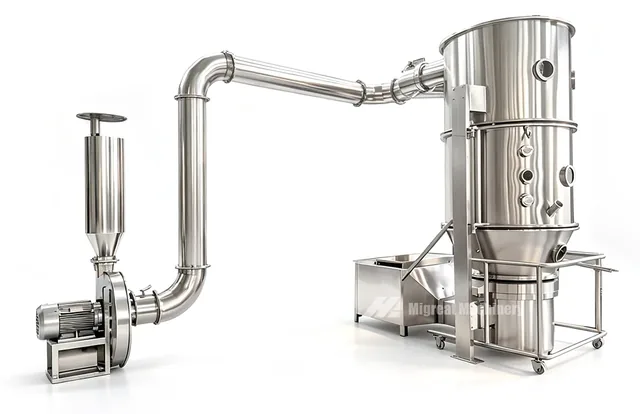
- Fluid bed granulation, mix, granulate and dry in one closed bed
- Moisture and heat tolerance of the powder decide first
A page on dry granulation usually starts from the tablet press and ends at a regulation. That suits a pharmaceutical formulator and does not help a plant manager who wants to know which machine to buy for a powder that cakes. This page stays with the equipment, which is where the cost and the risk sit.
It compares dry, wet and fluid bed granulation on the points that decide a purchase, explains how each machine works, reads the GK and FL tables and works through a sizing example. It does not cover regulatory validation or tablet formulation, which belong to the product and the market and not to the machine. The wet route has its own page, the wet granulation process.
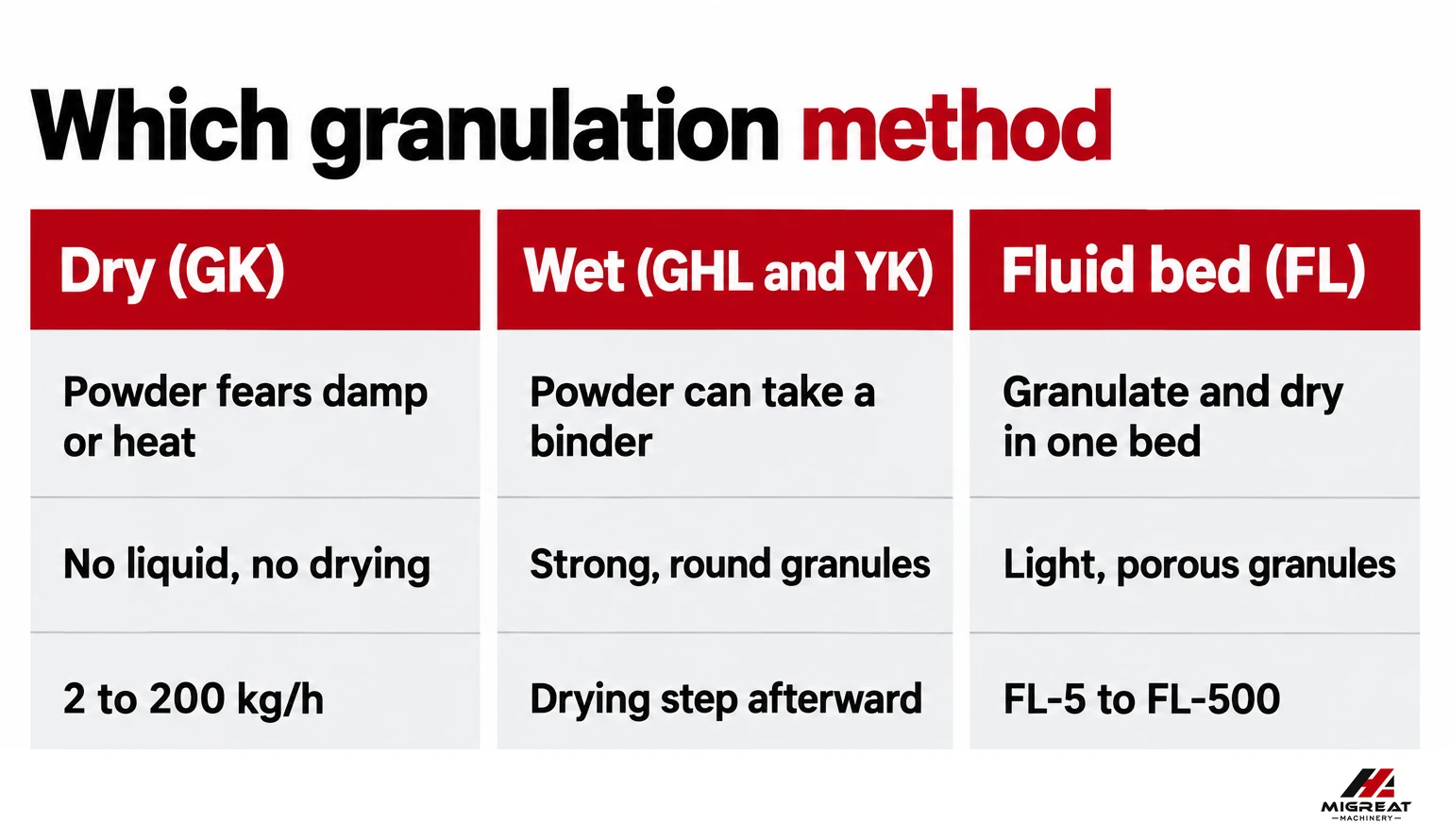
Dry, wet and fluid bed granulation in one table
The table already shows the split. Dry granulation is the only route with no liquid, and it is the answer when the powder cannot take moisture or heat. The two wet routes give stronger, rounder granules and handle most other powders, with the fluid bed route trading a longer cycle for fewer machines.
What is dry granulation and how does the GK work
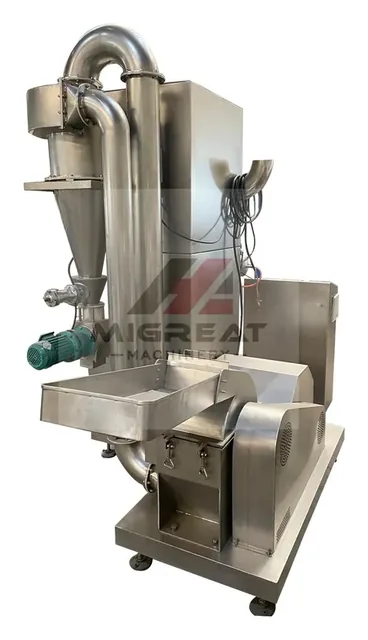
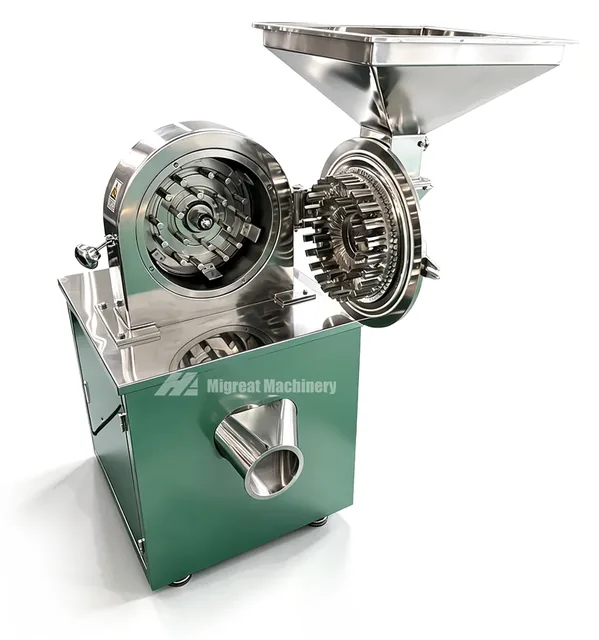
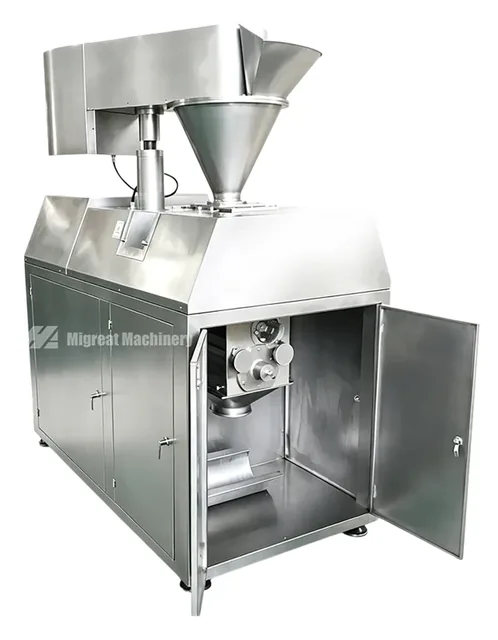
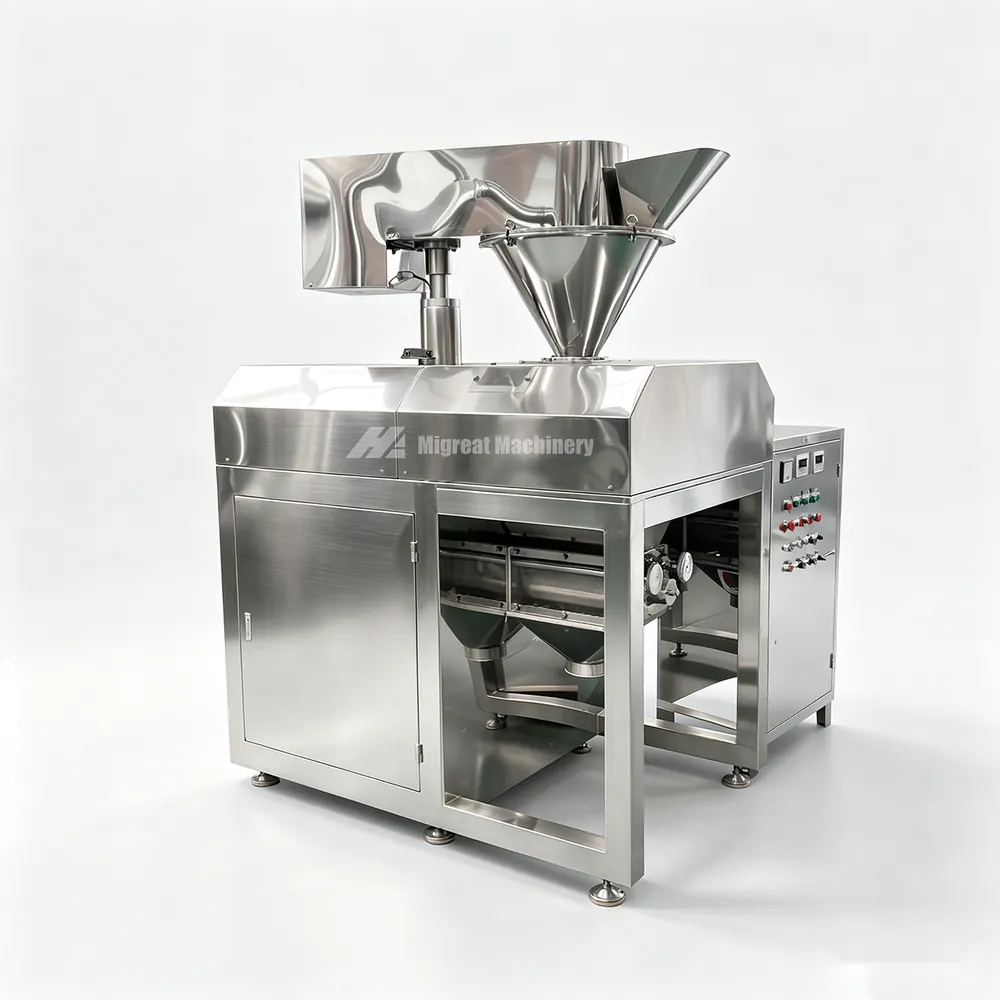
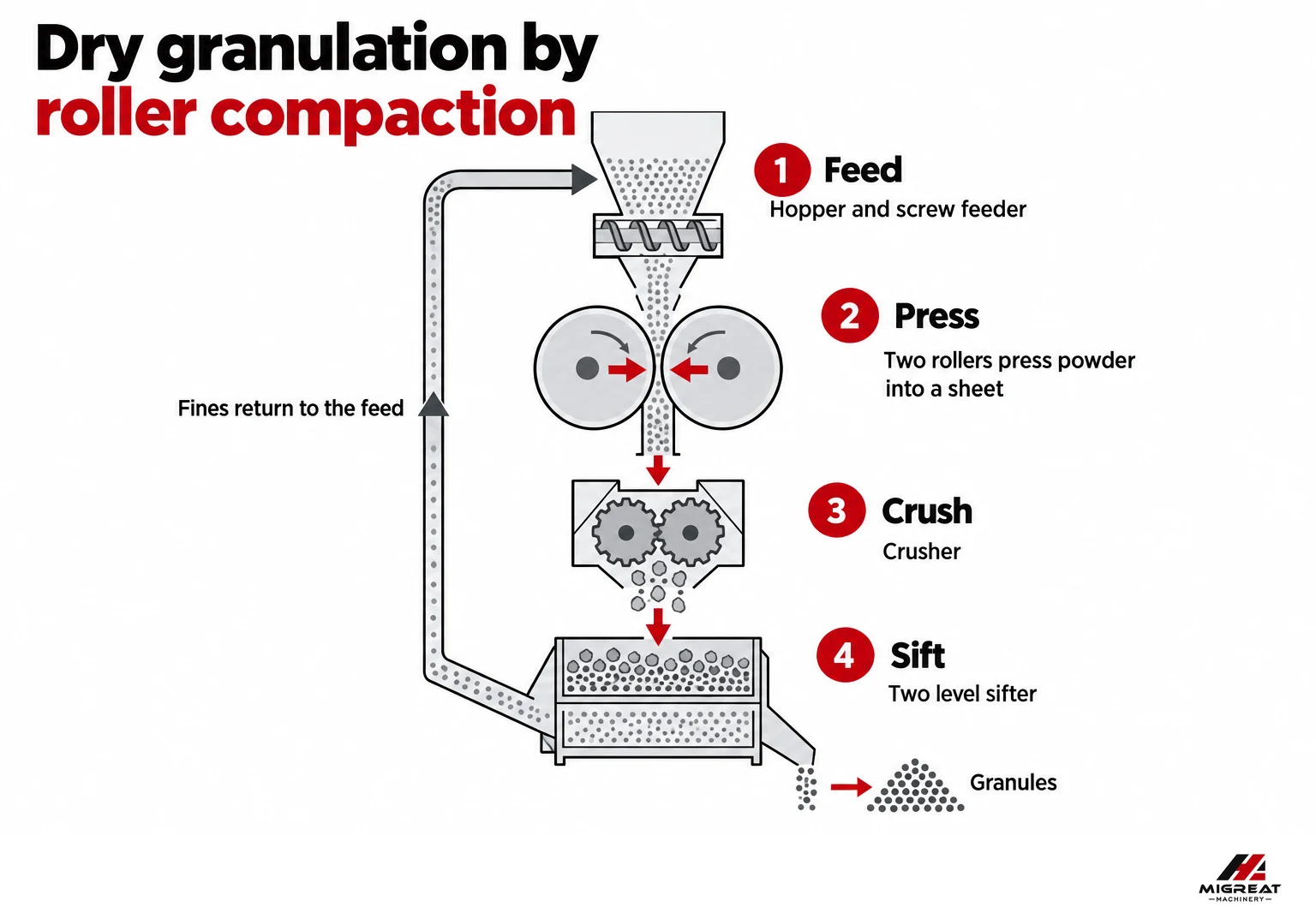
What is dry granulation in one line? It is granulation with no liquid binder. On the GK, a vertical screw feeder pushes powder between two rollers on cantilever shafts. The rollers press it into a sheet under a set pressure, and the sheet is crushed and sifted in two levels, with the fines returned to the feed.
The page states that the machine is closed, which keeps the dust under control, and that a PLC with a touch screen is optional. The roll speed runs from 2 to 20 rpm and the feed speed from 6 to 60 rpm, and the drive is electromagnetic or variable frequency. The maximum roll pressure runs from 5 to 25 tons depending on the model. Press, crush and sift are the whole process.
What wet granulation does instead
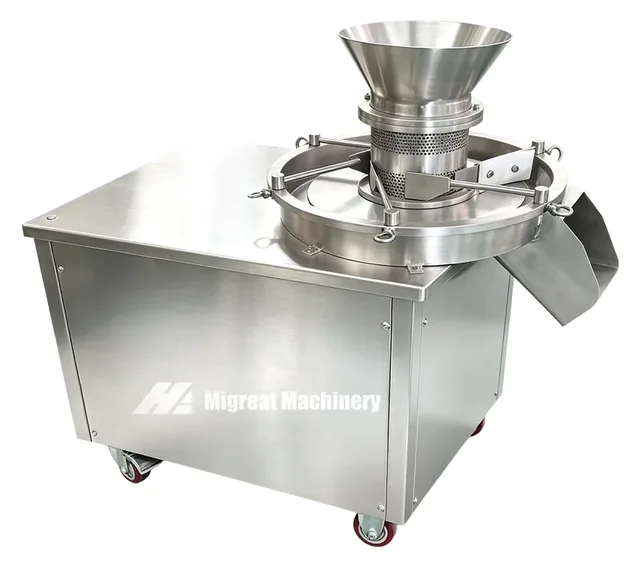
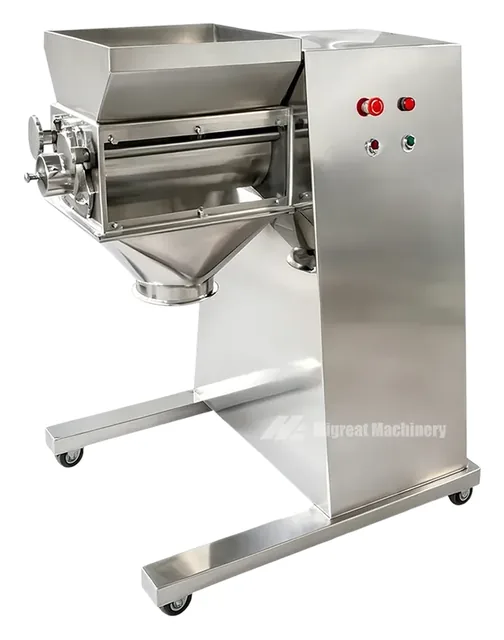
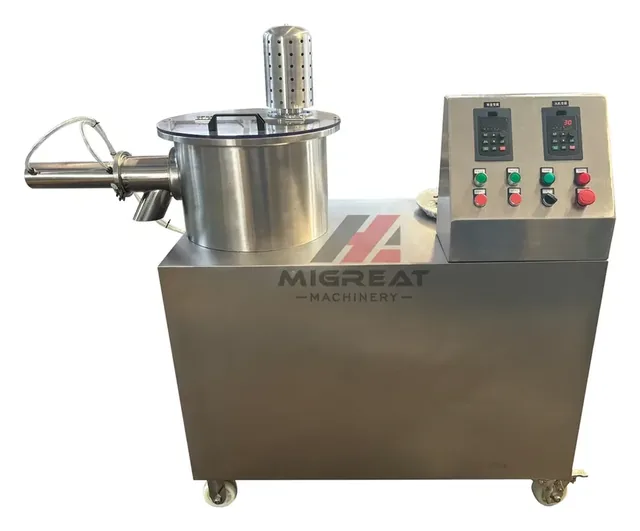
Wet granulation uses a liquid binder to stick particles together. The GHL high shear mixer granulator blends the powder, adds the binder while a cutter turns, and forms granules in 1 to 4 minutes of granulating inside a working time of 8 to 15 minutes. The wet granules are then sized, often on the YK swing granulator, and dried. The wet granulation method suits most powders that can take a little moisture, and the granules are strong and round.
The cost is the extra steps. A binder has to be made up, the wet mass has to be dried, and the dryer needs its own machine and time. The GFG batch dryer takes 15 to 30 minutes for the drying. Wet granulation therefore needs more floor space and more handling, and it depends on the material tolerating moisture and heat.
What fluid bed granulation does
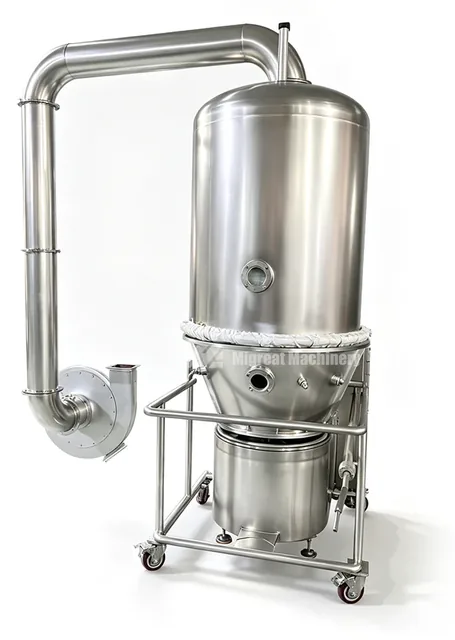
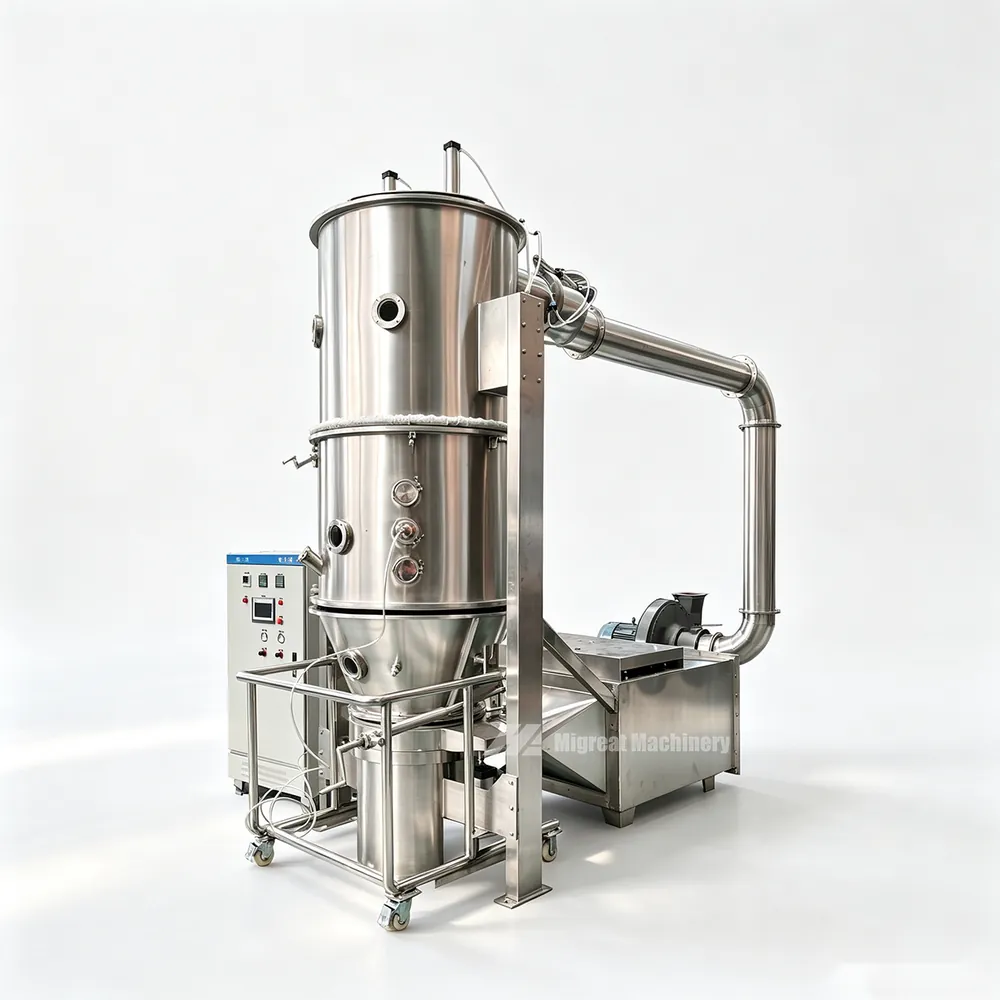
Fluid bed granulation is a wet method that builds the granules and dries them in the same machine. Hot air lifts the powder in a bowl, a peristaltic pump feeds binder to a nozzle that sprays it onto the powder, and the particles stick together into granules that dry in the same bed. The FL page says the process is closed, the discharge is three dimensional and oblique to empty the bowl, and the design meets GMP.
It saves machines and handling, and it makes lighter, more porous granules that flow well. The cost is a longer cycle, since the granule is built slowly in the air stream, and a more demanding process control. The wet granulation process page compares the high shear route and the fluid bed route in more detail.
Choosing by moisture and heat tolerance
The first question is whether the powder can take a liquid. A powder that reacts with water, cakes, or loses activity when wet cannot be wet granulated, and the same goes for a powder that cannot be dried afterward at the temperatures a dryer uses. For these the dry route is the answer. A powder that tolerates both can be granulated either way, and then the granule you want decides.
The second question is the granule. Dry granulation produces angular granules from a pressed sheet, with fines that return to the process. Wet granulation produces rounder, stronger granules. Fluid bed granulation produces lighter, porous granules. None of these is better in general, and the use of the granule decides, whether it is to be tableted, filled, dissolved or sold as a granulated product.
Check moisture tolerance
If the material cannot take liquid or drying, look at dry granulation.
Decide if drying is part of the job
A fluid bed granulator handles granulating and drying in one machine, and the high shear route needs a separate dryer.
Define the granule
Target size, strength and flow set how much shaping the process has to do.
Plan upstream and downstream
Granulation sits between mixing and drying or sifting in most powder lines.
Reading the GK model table
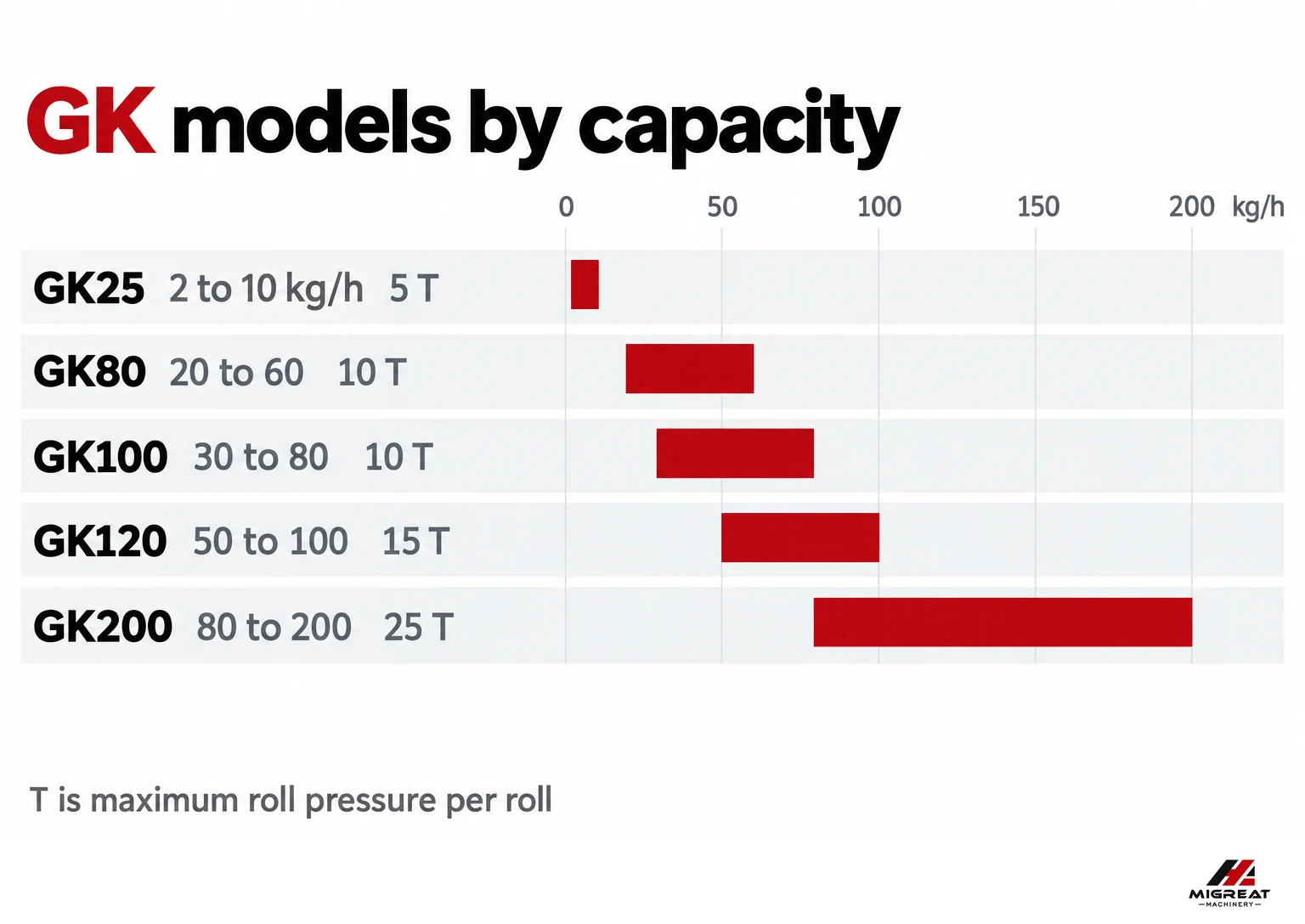
The GK comes in five sizes, from the GK25 at 2 to 10 kg/h to the GK200 at 80 to 200 kg/h. Roll width rises from 25 to 200 mm, the maximum roll pressure from 5 to 25 tons per roll, and the roll motor from 4 to 15 kW. The range is small compared with the wet and fluid bed machines, which is typical of roller compaction, where capacity depends on roll width and pressure.
Capacity and scale compared
The three routes cover different sizes. The GK tops out at 200 kg/h, the GHL makes batches of 3 to 300 kg, and the FL ranges from 4 to 6 kg in the FL-5 to 150 to 450 kg in the FL-300. Larger production is done by running several machines or by choosing the wet route, because roller compaction does not scale to tons per hour in the range listed here.
Units differ, so convert before comparing. A batch of 50 kg in a GHL-150 that takes 8 to 15 minutes works out to 200 to 375 kg/h, before the time for loading, discharge and drying. A GK120 at 50 to 100 kg/h is a small continuous line. If you need a few hundred kilograms an hour of granules from a moisture sensitive powder, the dry route needs more than one machine.
Advantages and disadvantages of dry granulation
The advantages are real. No binder is needed, so there is no wetting and no drying. The machine is closed, a variable frequency drive sets the speed, and a PLC and touch screen are optional. It suits damp and heat sensitive material, and it needs less floor space than a wet line with a dryer.
The disadvantages are as real. Capacity is limited to 200 kg/h on the largest model, the pressed sheet makes fines that must be returned, the granules are less round than wet granules, and the powder must be compressible, because a powder that springs back will not hold a sheet. The roll pressure also warms the material a little. If those limits bite, the wet or fluid bed route is the alternative.
A worked example, a moisture sensitive powder
A plant makes a vitamin premix that cakes when it meets water, at 80 kg/h of granules. The powder cannot be wet granulated and cannot take a dryer, so the dry route is the only one. The GK100 is rated 30 to 80 kg/h and the GK120 50 to 100 kg/h, so the GK120 holds 80 kg/h in the upper half of its range, with the GK200 as the choice if the plant grows.
The same plant with a powder that tolerates a binder at 300 kg/h of granules would look at a GHL-300 and a dryer, or an FL-300 fluid bed granulator. The GHL route mixes and granulates 130 kg per batch in 8 to 15 minutes, and the FL-300 takes 150 to 450 kg per batch. The choice then depends on the granule, the floor space and the cleaning.
Wet vs dry granulation in practice
Wet vs dry granulation is easiest to understand through what each does to the powder. Wet granulation dissolves part of the surface and lets the binder glue particles together, so the granule is strong and round, and the liquid has to be removed afterward. Dry granulation squeezes the particles together until they stay together, so the granule is angular and the strength comes from the pressure. The difference between wet and dry granulation is therefore a difference of how the particles are held, and every other difference follows from it.
That is why the choice is rarely about cost alone. A powder that dissolves, reacts or degrades in water has no wet option. A powder that does not compact has no dry option. Many powders have both, and then the granule decides. The table in the first section is the shortlist, and a trial on your powder is the proof.
The settings that move the granule
Each route has a few settings that do most of the work, and knowing them helps when you read a quotation. On the GK they are the roll pressure, the roll speed, the feed speed and the sifting. Higher pressure and slower rolls give a harder sheet and stronger granules, and a faster feed raises the output and can raise the share of fines. The page gives a roll speed of 2 to 20 rpm and a feed speed of 6 to 60 rpm, which is a wide window for tuning.
On the wet route the settings are the amount of binder, the mixing time and the cutter speed. More binder and a longer time give bigger, stronger granules. On the fluid bed they are the air flow, the temperature and the spray rate of the binder. In every case the first batch is a starting point, and the final settings come from a few trials with sieve results.
Fines, recycle and yield
Every granulation process makes some material that is too fine or too coarse. In roller compaction the pressed sheet breaks into granules and fines, and the fines go back to the feed. The GK page says the sheet is crushed and sifted in two levels and that fines return. A high recycle load lowers the output, and if the powder compacts poorly the load can climb until the machine is busy making the same granule twice.
Ask the supplier what recycle load the capacity figure assumes. A rated 100 kg/h of granule with a heavy recycle needs a feed rate well above 100 kg/h, and the sifting stage has to handle that. The same logic applies to wet granulation, where oversize wet lumps go back through the swing granulator and dry fines are returned to the next batch.
Cleaning and changeovers
Cleaning separates the routes sharply. A dry roller granulator is closed and dry, and a changeover means emptying the hopper, the rollers and the sifting stack, and wiping them. A wet line has a mixer bowl, a binder system, a granulator and a dryer, and each has to be washed and dried. A fluid bed has a bowl and filter bags to clean.
If the plant runs many products in small batches, the cleaning time can decide the route. For a plant that runs one product for weeks, it hardly matters. Ask each supplier how long a changeover takes and what it needs, and whether the contact parts can be washed in place.
Where granulation sits in a line
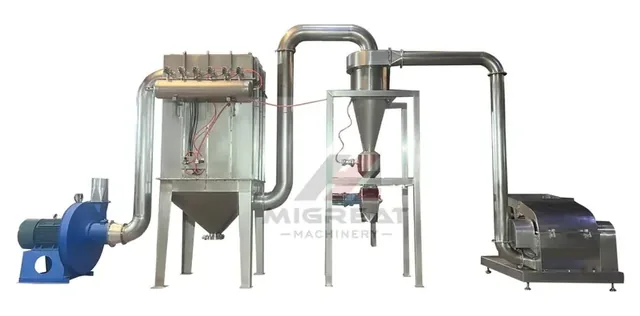
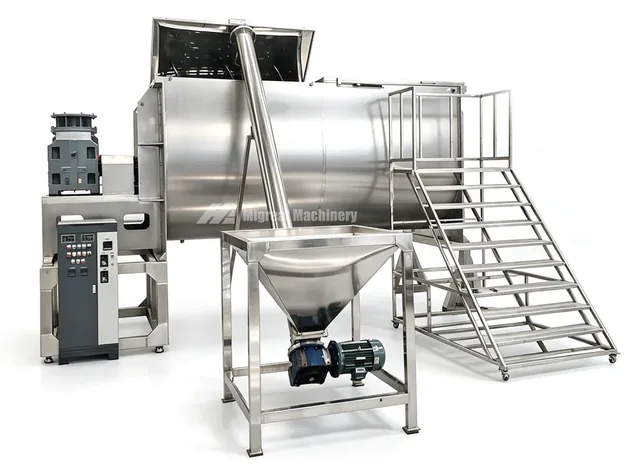
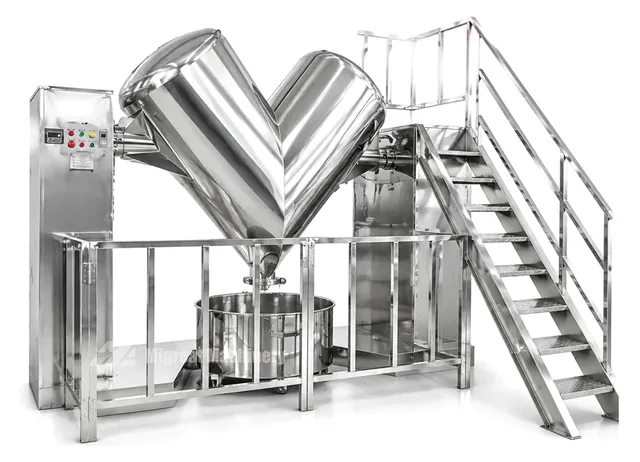
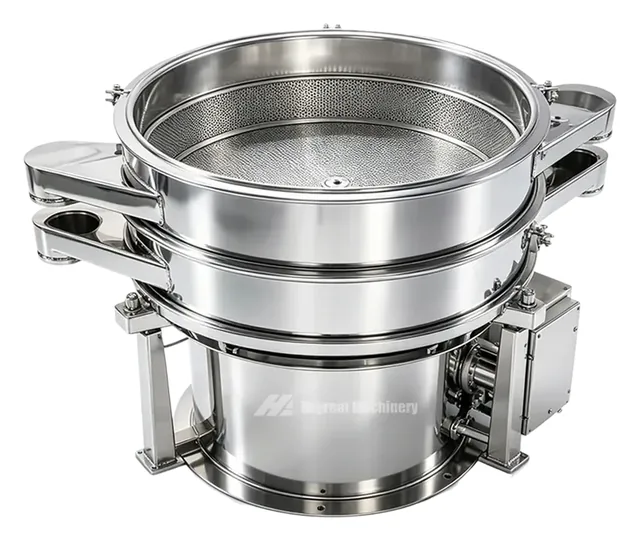
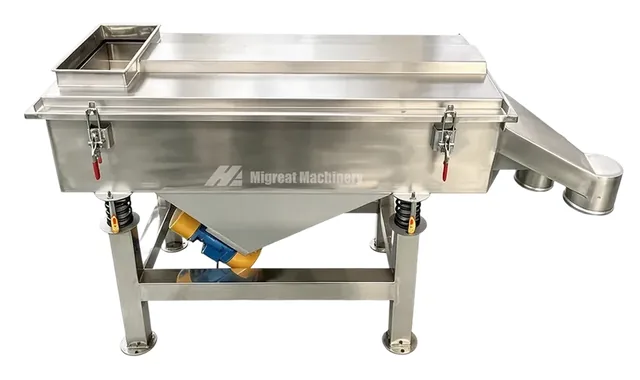
Granulation sits between mixing and the finishing steps. A blend from a V, 3D or ribbon mixer goes to the granulator, the granules are dried if the route is wet, and a vibrating sieve sizes them before packing. The integrated powder line page explains how those stages are linked.
The sieve is more important than it looks. Every granulation route makes a spread of sizes, and the sieve cuts it. Oversize goes back to be crushed, and fines go back to the process. Plan the loop, because a recycle load that is too high will cap the output of the line.
What the GMP statements mean for the machine
The FL and V blender pages mention GMP, and the FL page says its design meets GMP with small floor space and no dead corner. Read that as a statement about the machine, a smooth stainless steel surface with no places where powder can lie, and not as a statement about your process. Validation of a pharmaceutical process is a project of its own, with documents, qualification runs and records, and the machine supplier supports it but does not replace it.
If your product falls under such rules, ask the supplier for the documents they can provide, the material certificates, the surface finish, the drawings and the test records. Ask early, since the answer can change the contact materials and the price. The pages do not claim more than the design, and your own quality team decides what the product needs.
Mistakes buyers make
- Choosing wet granulation for a powder that cannot take liquid, and finding out in the first batch.
- Choosing dry granulation for a powder that will not hold a pressed sheet.
- Comparing a batch weight with a continuous rate as if they were the same unit.
- Forgetting the dryer when the route is wet, in the floor space and in the budget.
- Skipping a trial on the real powder, with the granule measured after sifting.
What to ask in the quotation
- The powder, its moisture, its heat limit and whether it holds a pressed sheet.
- The granule size and the share of fines, measured after sifting.
- The capacity at that granule, and the recycle load assumed.
- The cleaning and the changeover time between products.
- A trial on your own powder before the order, and the data from it in writing.
Granulators at work
The videos show a dry roller granulator, a swing granulator on wet powder and a fluid bed granulator making coffee granules.


Decide by moisture tolerance first, then the granule you need, and prove it with a trial on your own powder.
Send the powder, its moisture and heat limits, the granule you want and the capacity through the contact page, and an engineer can recommend a route. The GK dry roller granulator and FL fluid bed granulator dryer pages list the models, and the granulation equipment page shows the range.
Granulation FAQ
QWhat is the difference between wet and dry granulation?
Wet granulation uses a liquid binder and a drying step, while dry granulation presses powder between rollers with no liquid. Fluid bed granulation is a wet method that granulates and dries in one bed. Dry granulation suits material that cannot take liquid or heat.
QWhat does dry granulation mean?
It means making granules from powder with no liquid binder. On the GK, a screw feeder pushes powder between two rollers that press it into a sheet, and the sheet is crushed and sifted in two levels, with the fines returned to the feed.
QWhat is roller compaction granulation?
Two rollers on cantilever shafts, arranged vertically, press the powder into a sheet under a set pressure of 5 to 25 tons depending on the model. The sheet is then crushed and sifted into granules. It is another name for dry granulation by roller compactor.
QWhat are the advantages of the dry granulation method?
No binder liquid is needed, so there is no wetting and no drying. The machine is closed to keep dust under control, a variable frequency drive sets the speed, and a PLC with touch screen is optional. It suits damp and heat sensitive powder.
QWhat are the disadvantages of dry granulation?
Capacity on the GK stops at 200 kg/h, the pressed sheet makes fines that must be returned, granules are less round than wet granules, and the powder must hold a pressed sheet. A powder that springs back will not compact well.
QWhy choose fluid bed granulation?
It mixes, granulates and dries in one closed bed, so one machine does three steps. The FL runs ten sizes from FL-5 to FL-500 and meets GMP. The cycle is longer than a high shear route, and the granules are lighter and more porous.
QWhich is better, dry or wet granulation?
It depends on the powder. Dry granulation suits material that fears damp and heat, because it needs no wetting and no drying. Wet granulation gives stronger, rounder granules and handles most powders that tolerate a binder. Start from moisture tolerance.