 +86 139 1520 0887
 info@migreatmachinery.com
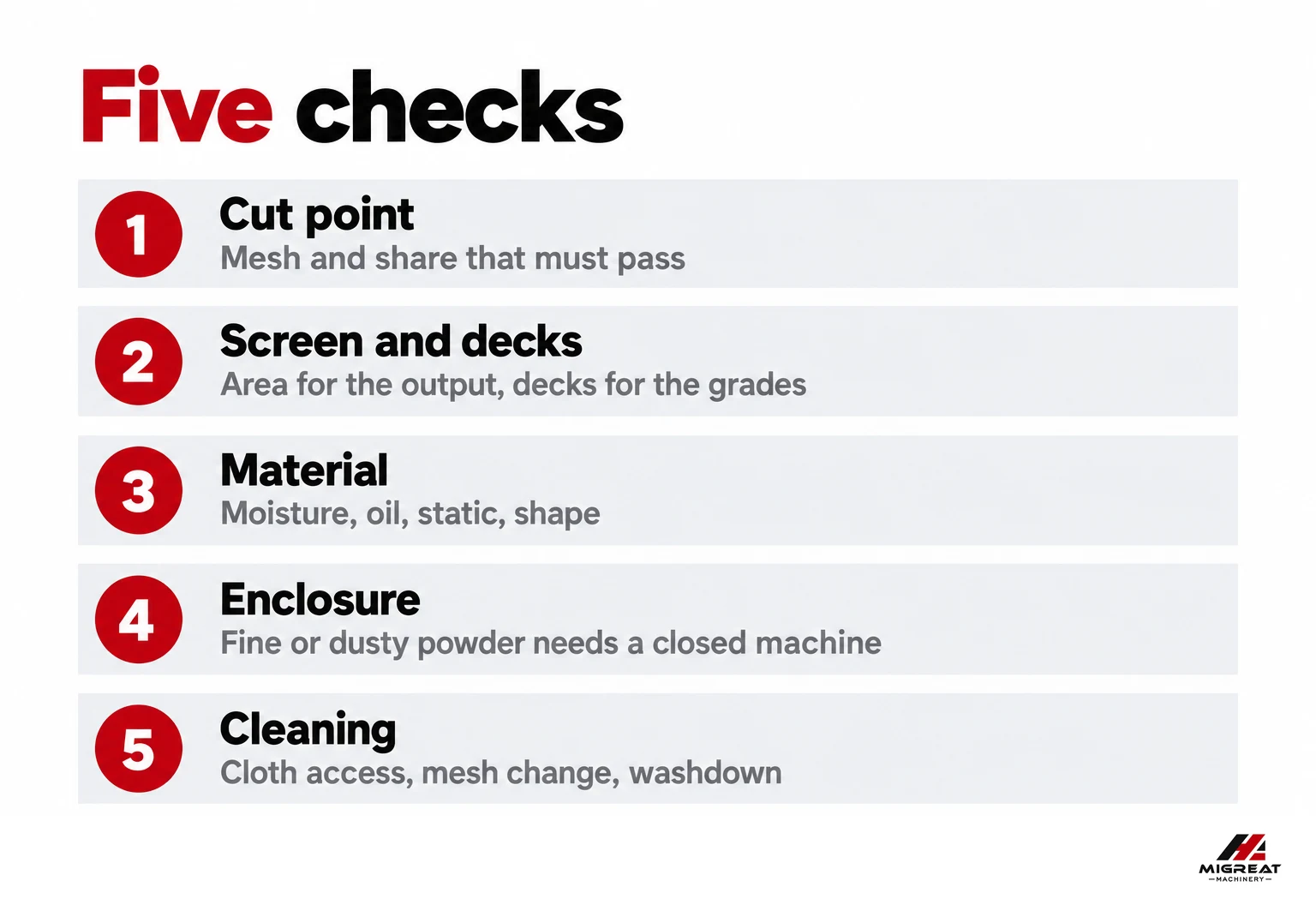
How to choose a vibrating sieve comes down to five checks, taken in order. The cut point in mesh, the size of the screen and the number of decks, how the material behaves on the cloth, whether the machine must be enclosed, and how fast the screen can be cleaned and changed.
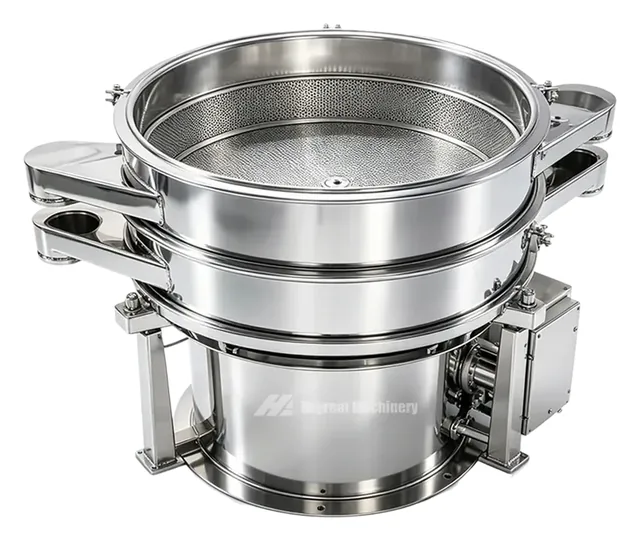
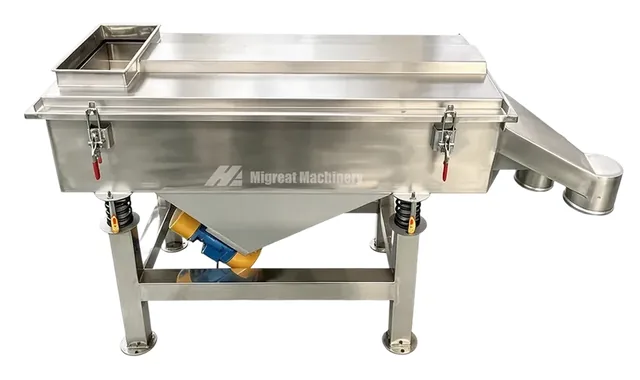
Migreat builds two kinds. The ZS vibrating sifter is round and fully enclosed, from 400 to 2,000 mm across, with one to five decks and a bouncing ball under the cloth that keeps the mesh clear. The ZQ linear sieve shakes a rectangular box in a straight line over up to four decks and handles particle sizes from 0.074 to 60 mm.
- ZS round sifter, 8 models, 0.2 to 2.5 kW, feed up to 20 to 60 mm
- ZQ linear sieve, 5 models, two motors at 960 rpm, amplitude 4 to 8 mm
- Decks give several grades in one pass, one to five on the ZS and one to four on the ZQ
- Fine, sticky, static or oily powder can blind a screen, and the quote request should say so
A sieve looks like the simplest machine on a powder line, and it is the one most often bought on a single number. The buyer names a mesh, the supplier names a diameter, and a month later the screen is blinded or the oversize is passing through. The mesh is only one of five things that decide the result.
This page gives a method for how to choose a vibrating sieve and size it, compares the round and linear types, explains how each one moves the powder, reads both model tables and works through an example. It does not cover rotary centrifugal sifters or air jet sieves, which are different machines with their own limits.
How to choose a vibrating sieve in five checks
Work through five questions in order. Each one narrows the list, and by the fifth only a few machines are left. Skipping the early ones is the usual cause of a screen that works in the test and fails in production.
Set the cut point
Decide the mesh that separates good powder from oversize, and the share of the powder that must pass it. The mesh to micron chart turns the number into a size.
Size the screen and the decks
The screen area must carry the output of the mill, and the number of decks must match the number of grades you want in one pass.
Study the material
Moisture, oil, static charge and particle shape decide whether the cloth will blind. Say what the powder does, not only what it is.
Decide how closed it must be
Fine, dusty or hygiene sensitive powder points to a fully enclosed machine. Coarser, free flowing material may be fine in an open one.
Plan cleaning and changeover
Check how the cloth is reached, how long a mesh change takes and how the machine is washed between products.
Every other point on how to choose a vibrating sieve is an expansion of one of those five. If you only have time for one, spend it on the third, because the material is the thing a datasheet cannot tell you.
The same machine goes by several names. People who search what is vibro sifter, vibro sifter principle or vibro sifter working are usually asking about the round vibrating sieve machine, which is the ZS here. A linear vibrating sifter is the long rectangular type, which is the ZQ. The names differ by region and the machines differ in how they move the powder, which is what the rest of this page sorts out.
Round sifter or linear sieve
The two types differ in the shape of the screen and the path the powder takes across it. The ZS is round, with an upright motor that moves the screen in three dimensions. The ZQ is a long rectangular box shaken in a straight line by two motors turning in opposite directions. The photographs show both.
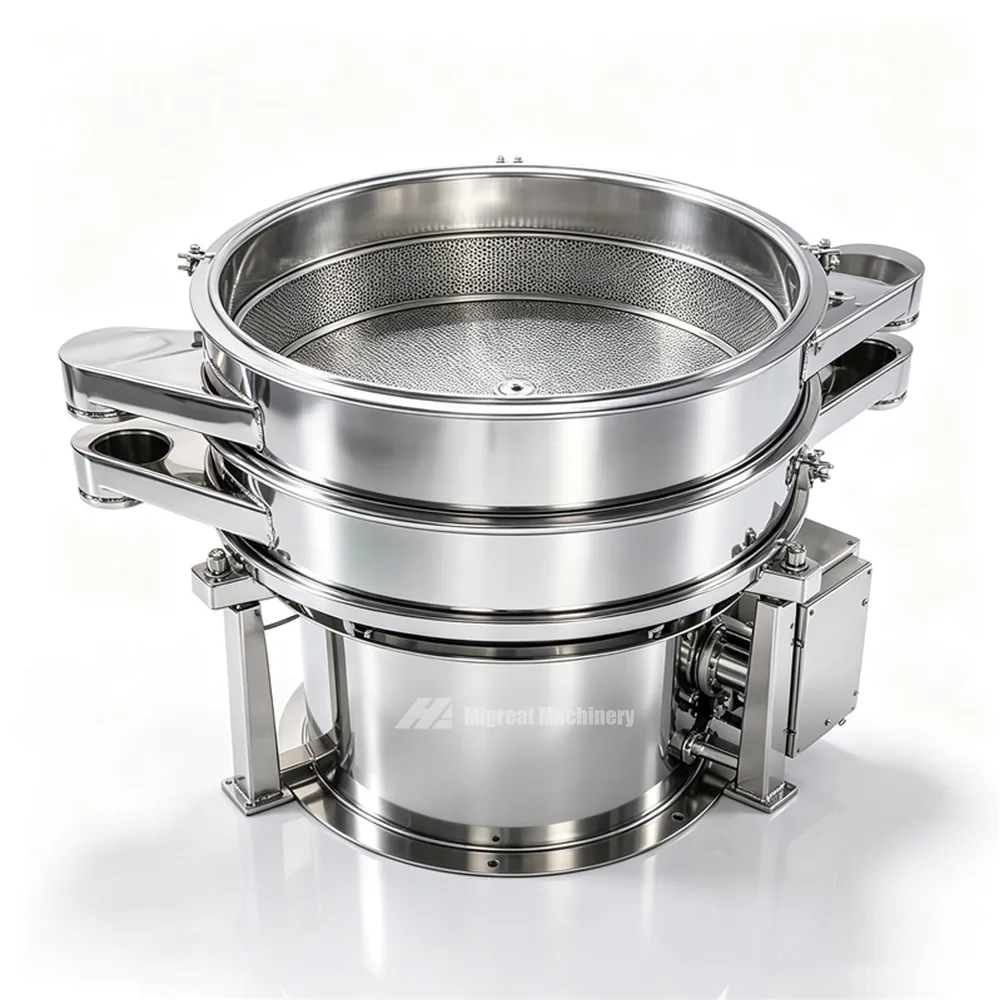
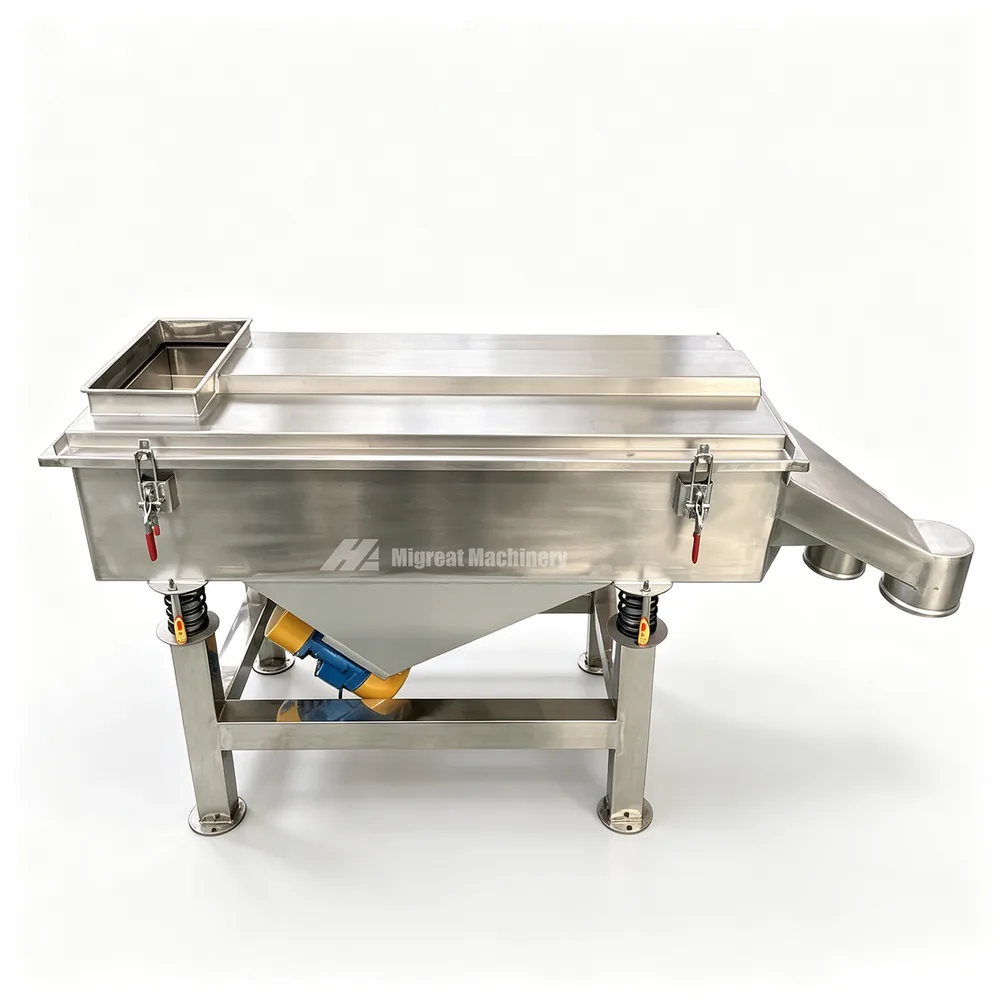
Read the table as a first filter and not as a verdict. Both are used for food, pharmaceutical and chemical material according to the pages. The practical split is that the round sifter is the tidy choice for fine powder that must stay inside the machine, and the linear sieve is the choice when the capacity is large, the particles are coarser or the line is long and flat.
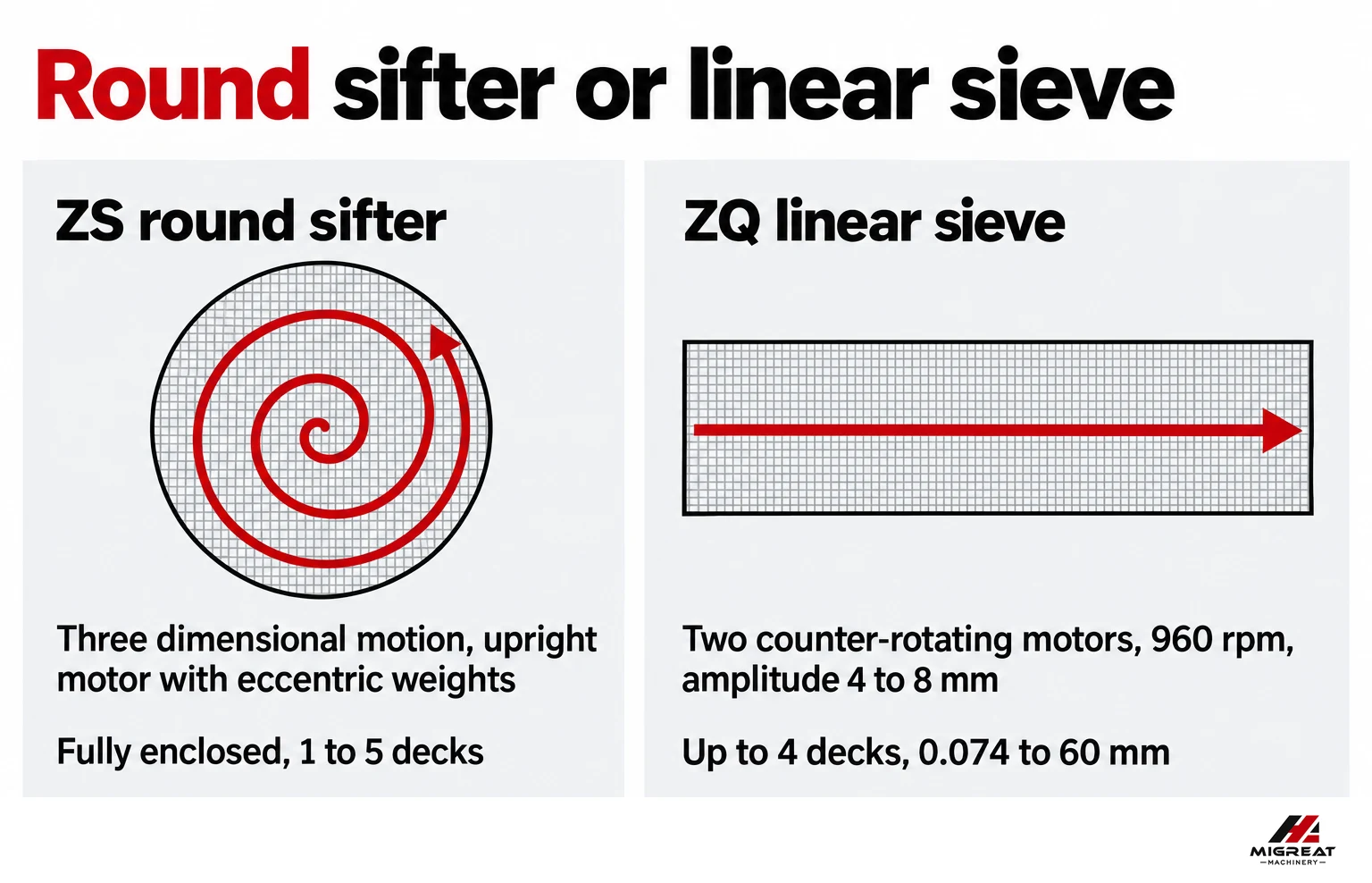
How the ZS round sifter moves the powder, the vibro sifter working cycle
An upright motor with an eccentric weight at each end shakes the screen in three dimensions. The vibration spreads the powder from the center toward the rim, tumbles it over the cloth and lets the fine fraction fall through. The powder travels a spiral path that gives it a long time on the screen in a small floor area.
The path can be tuned. The ZS page says that changing the phase angle between the upper and lower weights changes how the material travels, and so how long it stays on the screen. A longer stay gives a cleaner cut and a lower capacity. A shorter stay does the opposite. This is the adjustment your operator will use most, and it is worth asking how it is changed and who is allowed to change it.
How the ZQ linear sieve moves the powder
Two vibration motors mounted at the bottom turn in opposite directions at 960 rpm. Their sideways forces cancel, and the forces along one axis add, so the screen box vibrates in a straight line with an amplitude of 4 to 8 mm. The powder is thrown forward along the box and passes over up to four layers of mesh, with each layer taking out one size.
The straight path is usually steadier than a circular one at high throughput, because material moves in one direction and does not pile up. The cost is floor space, because the box is long. The ZQ models run from 500 by 2,000 mm up to 1,600 by 5,000 mm, and the longest one needs a room to match.
The bouncing ball and why screens blind
Blinding happens when particles wedge into the openings or coat the wires until the cloth no longer passes powder. Fine, sticky, oily and statically charged material does it fastest. The effect is gradual, and the capacity falls over a shift while the operator blames the powder.
The ZS page describes a special cleaning device. A bouncing ball sits under the screen cloth and jumps up and down while the cloth shakes, knocking particles out of the openings. The page says this effectively avoids clogging. It is a fair design answer to a real problem, though it does not make every powder sievable. If your powder is oily or damp, ask for a test with your own material before you trust it.
Mesh, cut point and the number of grades
The mesh sets the cut point, and the number of decks sets how many grades come out of one pass. A single deck splits the powder in two, the part that passes and the part that stays. Each extra deck adds one more grade. The ZS offers one to five decks and the ZQ one to four, so a four deck machine can give five grades from a single feed.
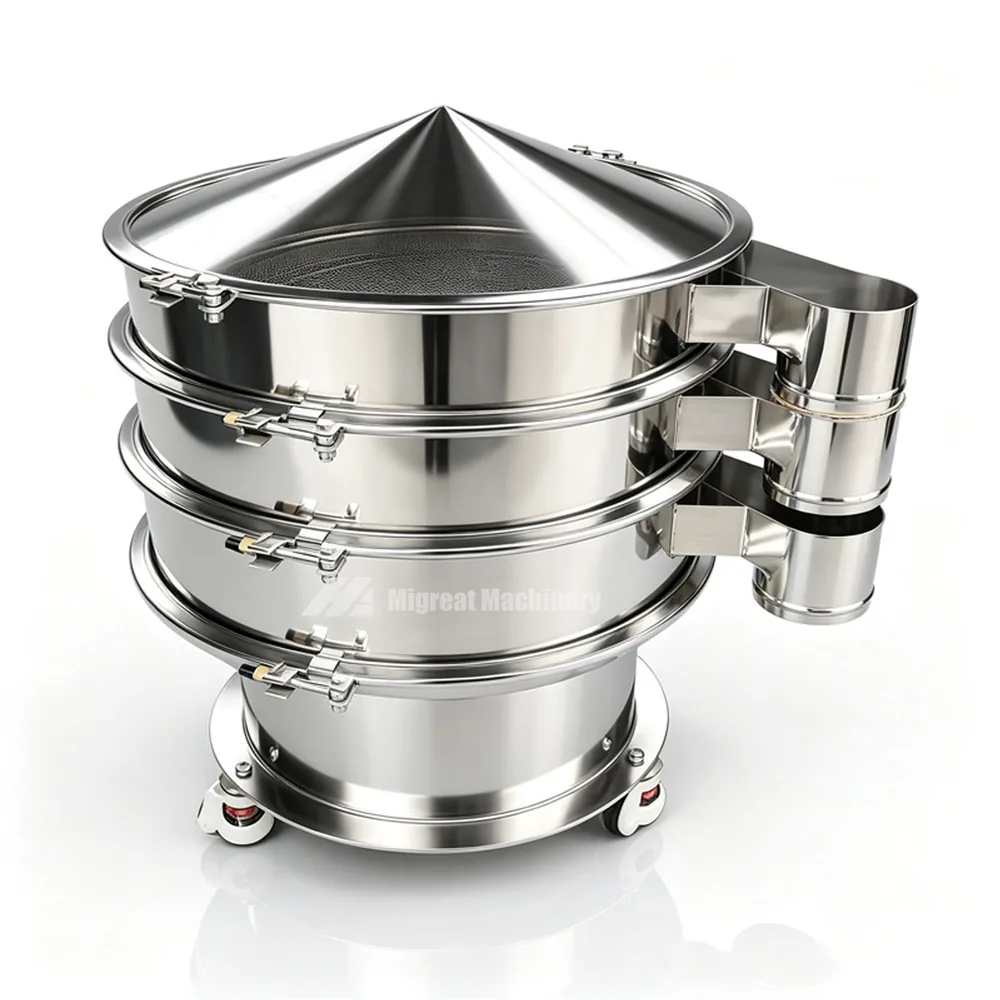
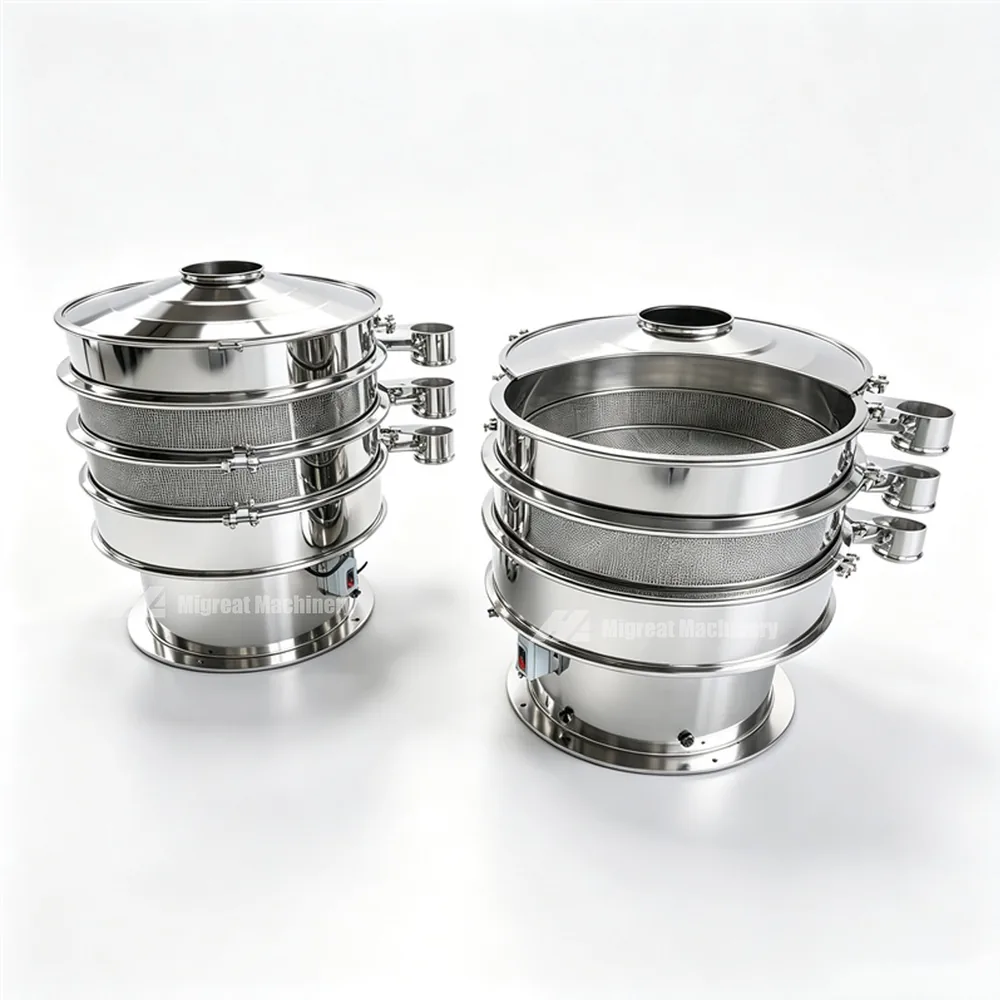
Name the mesh in a way both sides can test. A mesh such as 60 is a quarter of a millimeter on the US series, and the mesh to micron chart shows the other sizes. The ZQ page gives its working range as 0.074 to 60 mm, and 0.074 mm is 74 microns, close to the 200 mesh opening. That is the practical lower edge for a screen of this type, and finer cuts are normally made by classifiers.
How to think about capacity
Capacity is the number buyers ask for first and the one a table cannot give. It depends on the open area of the cloth, on the mesh, on the bulk density and moisture of the powder, and on how clean a cut you want. A coarse cut on dry, free flowing powder passes a great deal. A fine cut on sticky powder passes very little. Neither the ZS nor the ZQ page lists a capacity, and that is honest, because any figure without a mesh and a material would be a guess.
The better question is how much screen area the job needs. Ask the supplier for the capacity at your mesh on your material, and ask which diameter or box size it assumes. Then check that the mill output sits comfortably below it, because a screen run at its limit gives a poor cut. If you are still working out how to choose sieve size for a line, size the mill and the screen together, and leave room for a mesh change later.
Reading the ZS model table
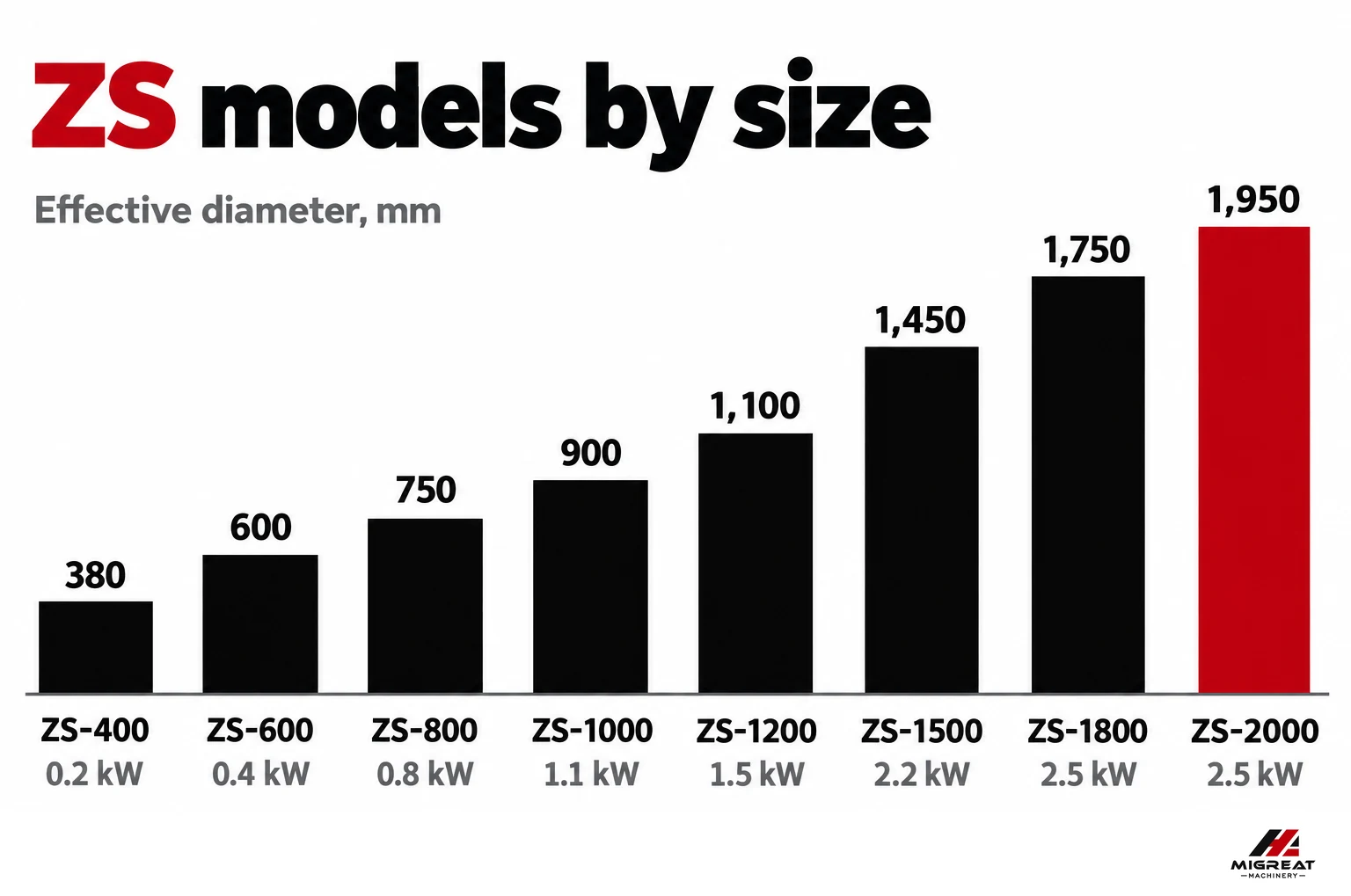
The ZS comes in eight diameters. Power rises from 0.2 kW on the ZS-400 to 2.5 kW on the ZS-1800 and ZS-2000. The largest feed size that the screen accepts rises from 20 mm to 60 mm. The number of decks offered falls at the largest sizes, probably because a stack of several decks on a two meter screen would be very tall.
The effective diameter is the working area of the cloth, a little smaller than the machine diameter. The effective screen area grows with the square of the diameter, so a ZS-1200, at 1,100 mm effective, has about three and a half times the area of a ZS-600. That is the number that matters for capacity, and the table gives no capacity figure, so ask for one for your material at your mesh.
Reading the ZQ model table
The ZQ comes in five sizes. The effective screen runs from 500 by 2,000 mm to 1,600 by 5,000 mm, and the motors from 2 of 0.75 kW up to 2 of 3.0 kW. Every model runs at 960 rpm with an amplitude of 4 to 8 mm and handles 0.074 to 60 mm. The choice among the five is a question of screen area and power, and the vibration itself is the same throughout.
The model names read as the width and length in decimeters, loosely, but the table is the safe source. Note that the ZQ-840 is longer than the ZQ-1030 even though its number is lower, so the name does not rank the screen area. Compare the width multiplied by the length instead.
What the material does to the screen
The material decides more than the mesh does. The table lists the usual troublemakers, what each does on the cloth and what to ask for. Use it when you write the enquiry.
Dust, enclosure and hygiene
A sieve is a place where powder is thrown about in the air, and an open one fills the room with dust. The ZS is sealed and fully closed, and the page says this keeps powder out of the environment. For food, pharmaceutical and chemical material that is a real advantage, and it also keeps the room air out of the powder.
For the ZQ the page does not state an enclosure, so ask. A cover, a dust hood and a connection to the collector are common options on linear sieves, and the answer should be in the quotation. Contact parts in stainless steel are the other hygiene point. The ZS page states stainless steel 304 for the sifter.
A worked example, a spice line
A plant grinds dried chili to 40 mesh and wants three products from one pass. A fine powder that passes 60 mesh, a medium grade between 60 and 40 mesh, and oversize that goes back to the mill. That asks for two decks, with a 40 mesh cloth on top and a 60 mesh cloth under it, and the oversize on the top deck returns to the grinder.
The feed from the mill is fine, well under the 20 to 60 mm limits on the tables, so the feed size does not decide. The material is dry spice, so blinding is a moderate risk and the bouncing ball on a ZS helps. Dust is the larger issue, because chili dust irritates, and that points to the fully enclosed ZS. At a few hundred kilograms an hour the mill output sets the screen area, and the supplier should size the diameter from your capacity and mesh.
If the same plant later adds a granulated product with pieces up to 10 mm, the linear sieve is worth a second look, because its range reaches 60 mm and its box handles more material per hour at the same width.
Where the sieve sits in the line
A sieve is a quality gate. It sits after the mill and before the packer, and it sends oversize back to the grinder and nothing coarse reaches the bag. In a spice line it is the last quality gate before packing. The spice grinding line page shows the order, and the integrated powder line page explains how the stages link up.
Fit the sieve to the mill, not the other way around. The mill produces a spread of sizes, and the sieve cuts it at one point. If the mill is run too coarse, the sieve returns a large share and the loop between them overloads. The particle size reduction page explains why the mill setting and the screen cut have to be chosen together.
Checking that the sieve does its job
The simple check is a hand sieve test on a sample from each grade. Weigh a sample, shake it over a test sieve of the cut mesh, and weigh what stays on top. If more than the agreed share of the fine grade stays on top, the cloth may be torn, the deck may be overloaded or the phase angle may need changing. Tear shows up as a sudden step in the oversize share, while blinding shows as a slow drift.
Keep a log of screen changes, since a log turns a vague complaint into a date and a mesh. Cloth wears, and the date it was changed and the mesh fitted should be written down with the batch number. That log is what explains a drift in the product months later.
Mistakes buyers make with sieves
- Naming a mesh without the share that must pass it, with the result that two parties test two different things.
- Buying on diameter alone and ignoring the effective screen area and the capacity at the mesh.
- Skipping a test with the real powder, then finding the cloth blinds after an hour.
- Choosing an open machine for a dusty or hygiene sensitive powder.
- Forgetting the spare cloths and the time a mesh change takes.
Questions to put in the quotation
Ask for these in writing, and compare quotations item by item and not by price alone.
- The capacity at your mesh on your material, and the screen area behind it.
- The mesh and wire of each cloth, and the cost and lead time of spares.
- The enclosure, the dust connection and the contact material.
- How the phase angle or deck order is changed, and how long a mesh change takes.
- A test on your own powder before the order.
Vibrating sieves at work
The videos show the ZS sifter screening powder and a food powder sieving run.


Choose the sieve from the material and the cut, not from the diameter alone, and ask for the capacity at your mesh.
Send the powder, the cut mesh with the share that must pass, the number of grades and the capacity per hour through the contact page. The ZS vibrating sifter and ZQ linear sieve pages list the models, and the sieving machines page shows the full range.
Vibrating sieve FAQ
QHow to choose a vibrating sieve and its size?
Start from the cut point. Mesh sets the size that separates good powder from oversize, so decide it first and say what share must pass. Then size the screen to the output of the mill and check how the material behaves, because fine, sticky, static or oily powder can blind the cloth.
QWhat is a vibro sifter used for?
The ZS vibrating sifter separates fine powder by size, such as wheat flour and corn starch, in food, pharmaceutical and chemical work. It is round and fully enclosed, from 400 to 2,000 mm, with one to five decks that give several grades in one pass.
QWhat is the working principle of a vibro sifter?
An upright motor with an eccentric weight at each end makes the screen move in three dimensions. The vibration carries the powder across the cloth and fine particles fall through. Changing the phase angle between the weights changes the path and the time on the screen.
QWhat is the difference between linear and round vibrating sieves?
A round sifter such as the ZS moves the screen in three dimensions, in a sealed round body. A linear sieve such as the ZQ has two counter-rotating motors that shake a rectangular box in a straight line at 960 rpm, with amplitude 4 to 8 mm, over up to four decks.
QHow do I stop a vibrating sieve from clogging?
Match the cloth to the material and use a cleaning aid. The ZS has a bouncing ball under the cloth that jumps while the screen shakes and keeps the openings clear. Oily, damp or very fine powder still needs a test on your own material before you trust it.
QHow many decks do I need?
One deck gives two products, the part that passes and the part that stays. Each extra deck adds one grade. The ZS offers one to five decks by model and the ZQ one to four, so a four deck machine can give five grades in one pass.
QCan a vibrating sieve make very fine cuts?
Down to a point. The ZQ page gives 0.074 mm, which is 74 microns, close to 200 mesh. Finer cuts are normally made by a classifier, for example the grading wheel of an air classifier mill, with a sieve used afterward to check the result.