 +86 139 1520 0887
 info@migreatmachinery.com
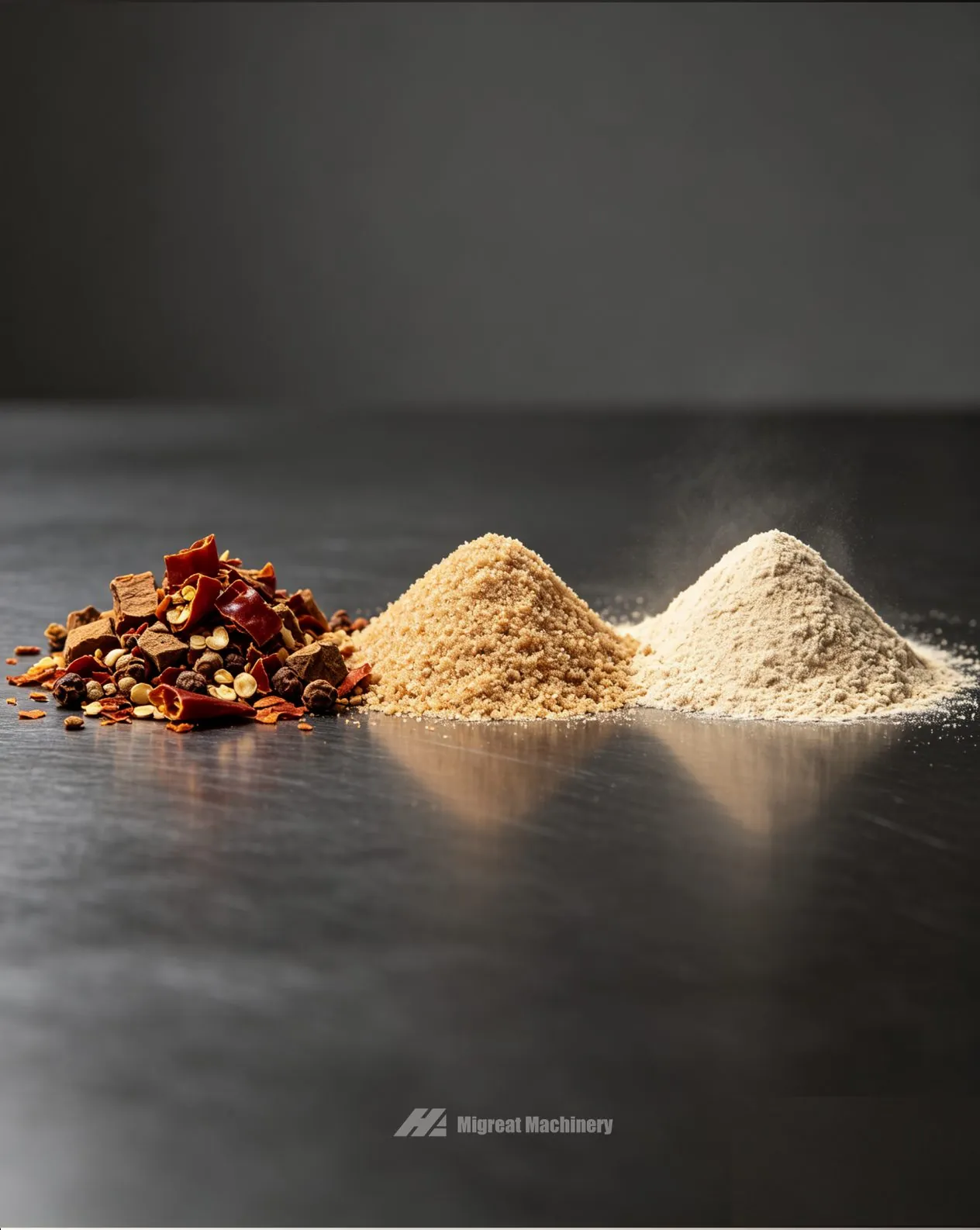
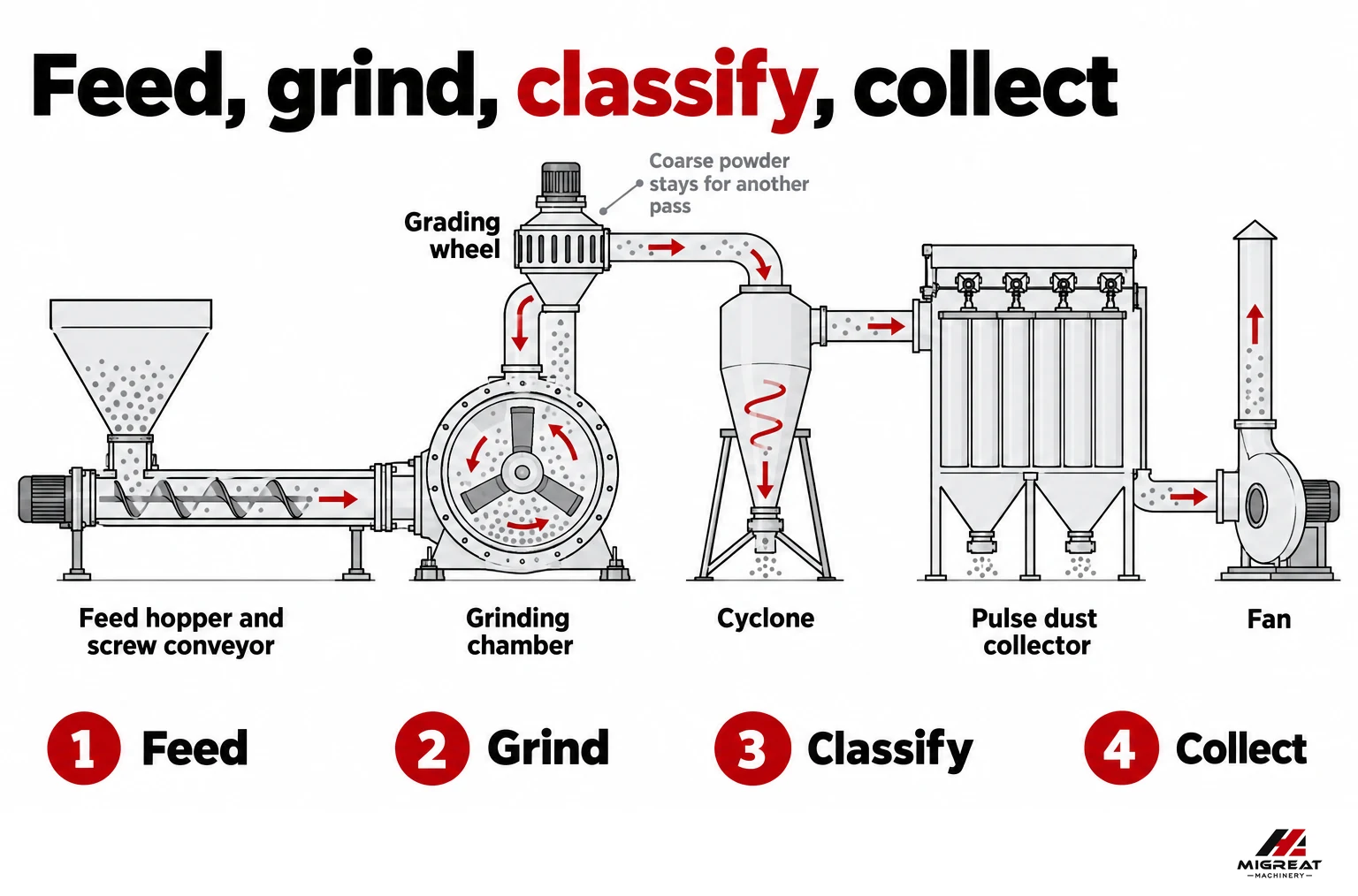
The air classifier mill working principle is grinding and sorting in one chamber. Fast turning blades break the material, an air stream carries the powder to a rotating grading wheel, and only particles small enough to pass the wheel leave the mill. Everything else drops back for another pass.
On the Migreat WFJ series the grading motor speed sets the fineness, from 80 to 800 mesh, and there is no screen. Fine powder leaves through a cyclone, dust goes to a pulse dust collector, and coarse powder stays in the chamber until it is fine enough. A faster wheel gives a finer cut.
- Feed, grind, classify and collect make one continuous run
- The grading wheel sets the top size, so no screen can clog
- WFJ models from 10 to 800 kg/h, total motor power 14 to 124 kW
- Capacity falls as the powder gets finer, so quote it at your mesh
Most explanations of the air classifier mill working principle stop at a block diagram with arrows. The diagram is correct, and it still leaves out the part a buyer needs, namely why turning one dial changes the fineness and what that dial costs in capacity and power.
The same machine is also called an air classifying mill, so a search for the air classifying mill principle or the air classifying mill working principle ends up at the same answer. Under either name the air classifier mill principle is a grinding stage and a sorting stage that share one air stream.
This page follows one particle through the WFJ mill, names the parts, explains what the grading wheel does in plain terms, reads the six models in the specification table and works through a sizing example. It also separates the air classifier mill from the air jet mill, because the two names are often mixed up. It does not cover laboratory classifiers or jet mills built for micron and submicron powders.
The air classifier mill working principle, in one pass
The air classifier mill working principle has four moves. A feeder meters material into the grinding chamber, fast turning blades cut it, air carries the powder to the grading wheel where only fine particles pass, and a cyclone and dust collector take the fine powder out of the air. Particles that are still too big never leave the chamber.
Feed
A screw conveyor moves material into the grinding chamber. An inverter sets the feeding speed, and the feed can be matched to the fineness you want. The feed size limit rises with the model, from 6 mm on the WFJ-15 to 20 mm on the WFJ-100.
Grind
Blades turning at high speed cut the material. The page for the WFJ calls out fast turning blades, and the main shaft speed in the table runs from 2,000 to 4,000 rpm depending on the model.
Classify
The air stream carries the powder to the grading wheel. Air force pulls fine particles through the wheel and centrifugal force throws coarse particles back. Only fine powder passes.
Collect
Fine powder leaves through the cyclone and the dust goes to the pulse dust collector. Coarse powder stays in the chamber for another pass.
The loop between grinding and classifying is what separates this machine from a screened mill. A screened mill lets a particle out as soon as it fits the hole. The classifier mill lets it out only if it fits the cut that the wheel is set to, and that cut can be far finer than any practical screen.
Air classifier mill diagram and parts
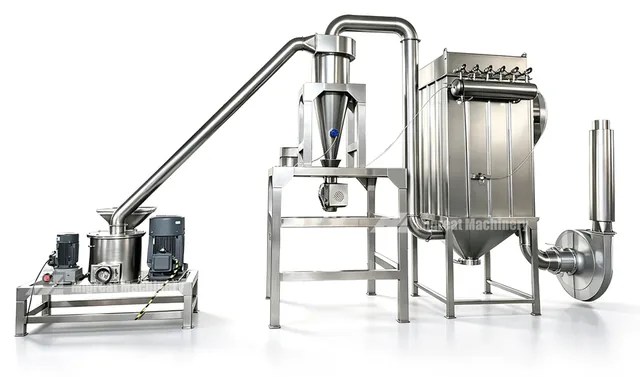
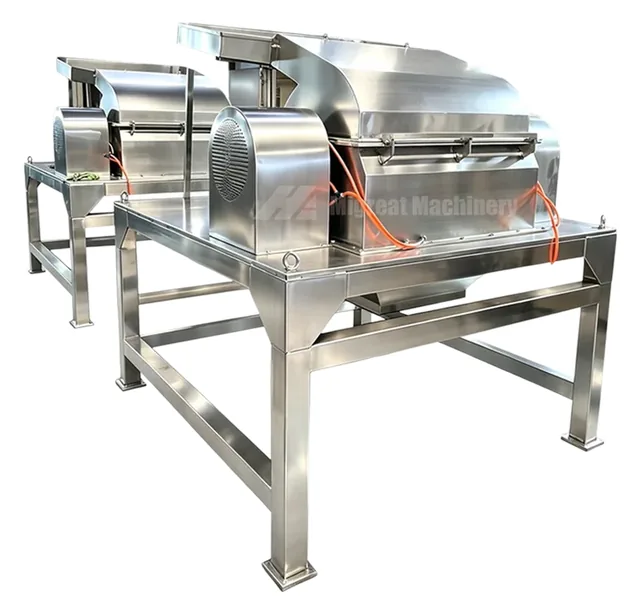
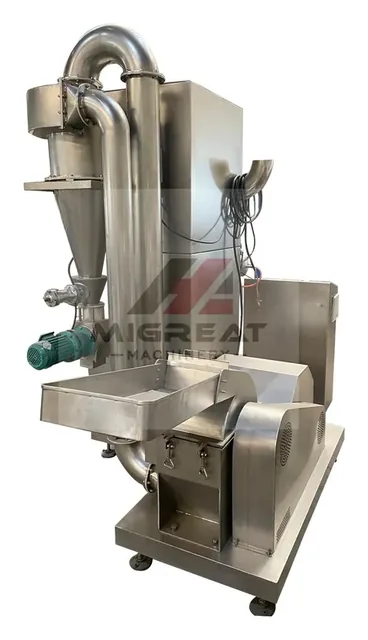
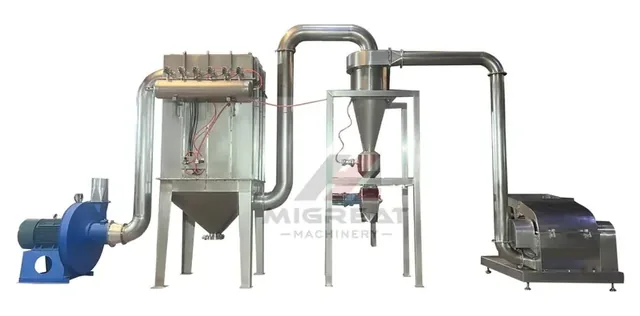
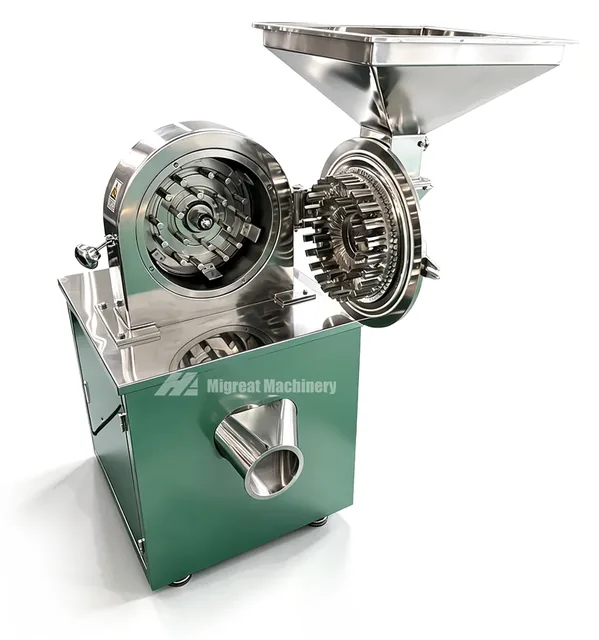
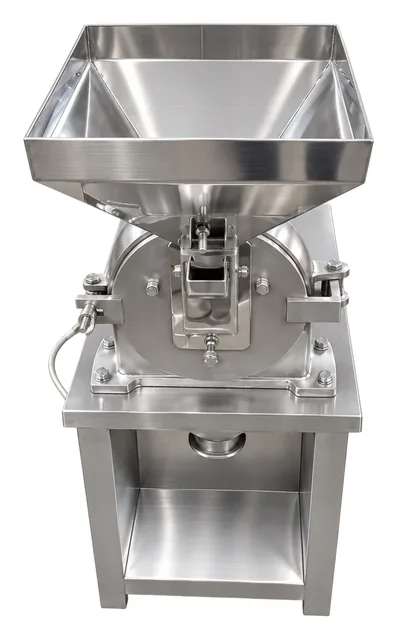
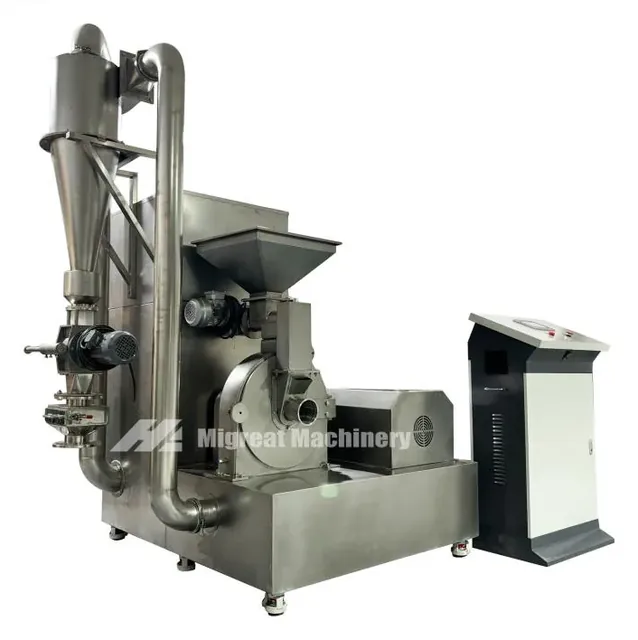
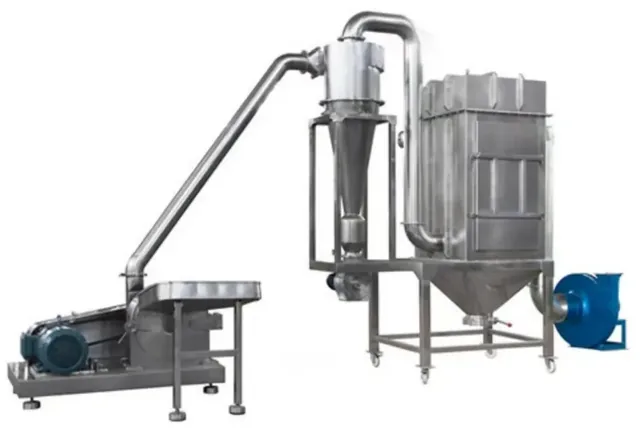
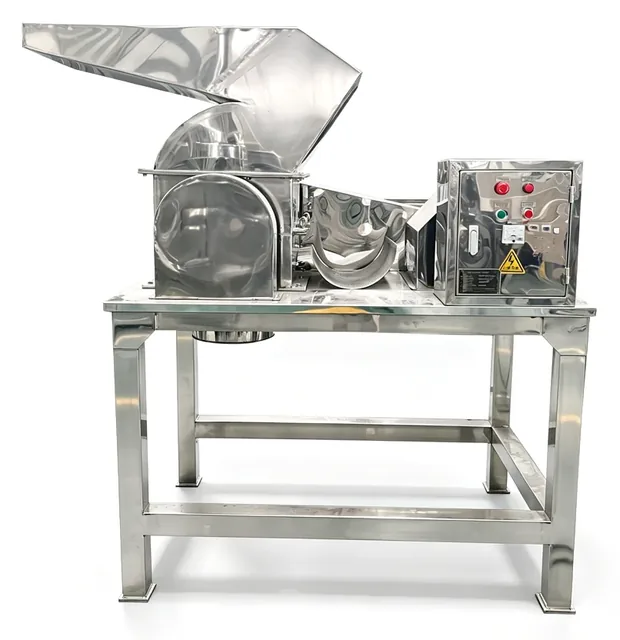
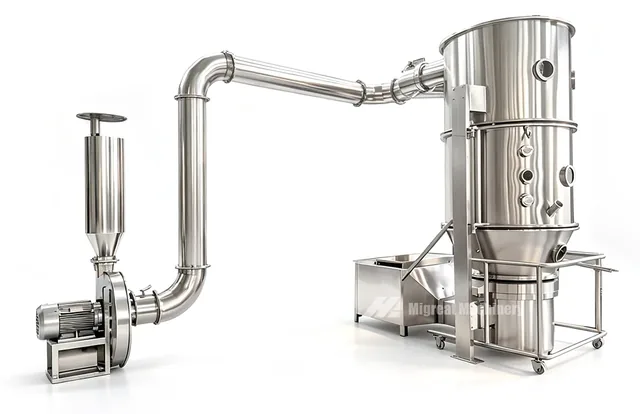
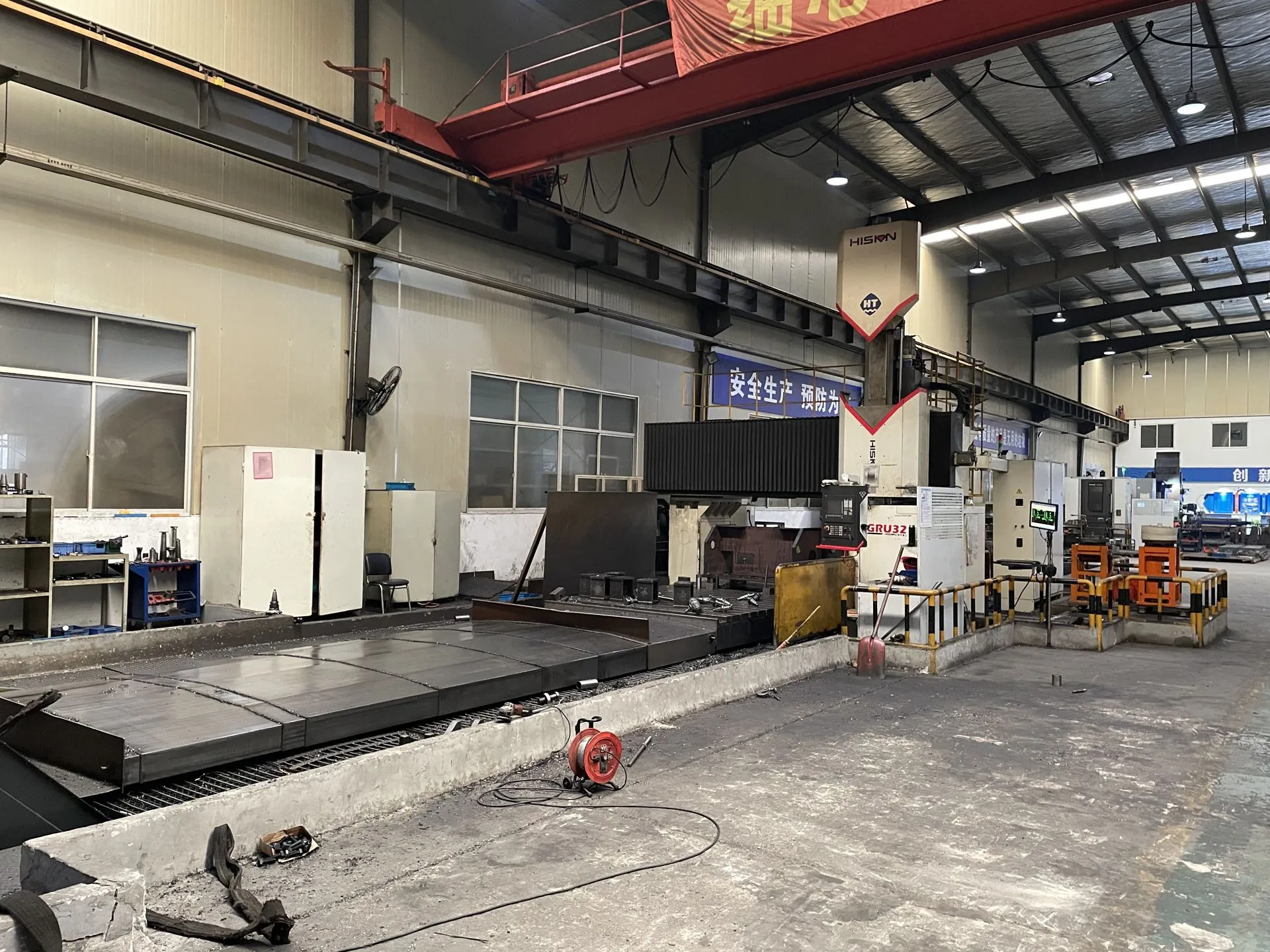
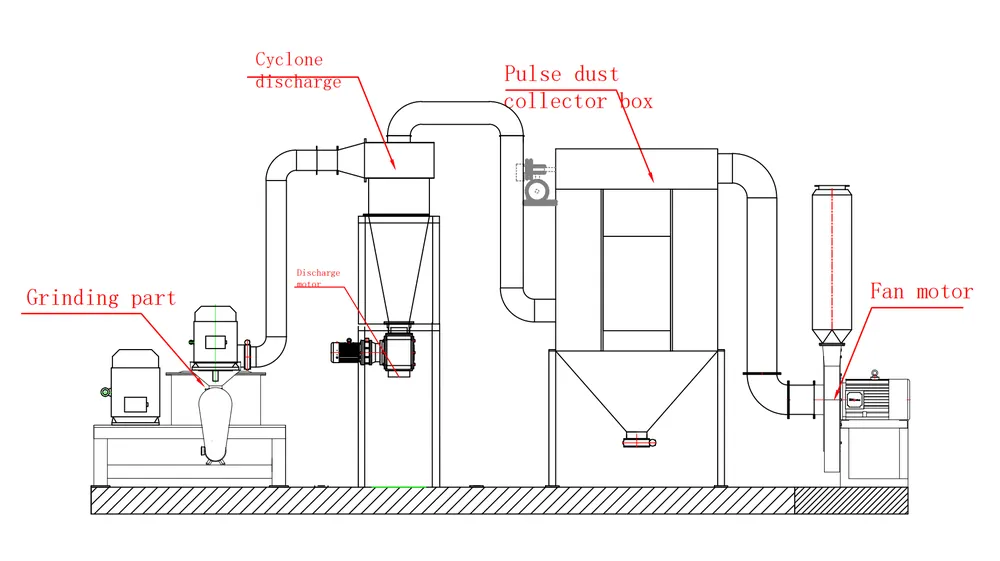
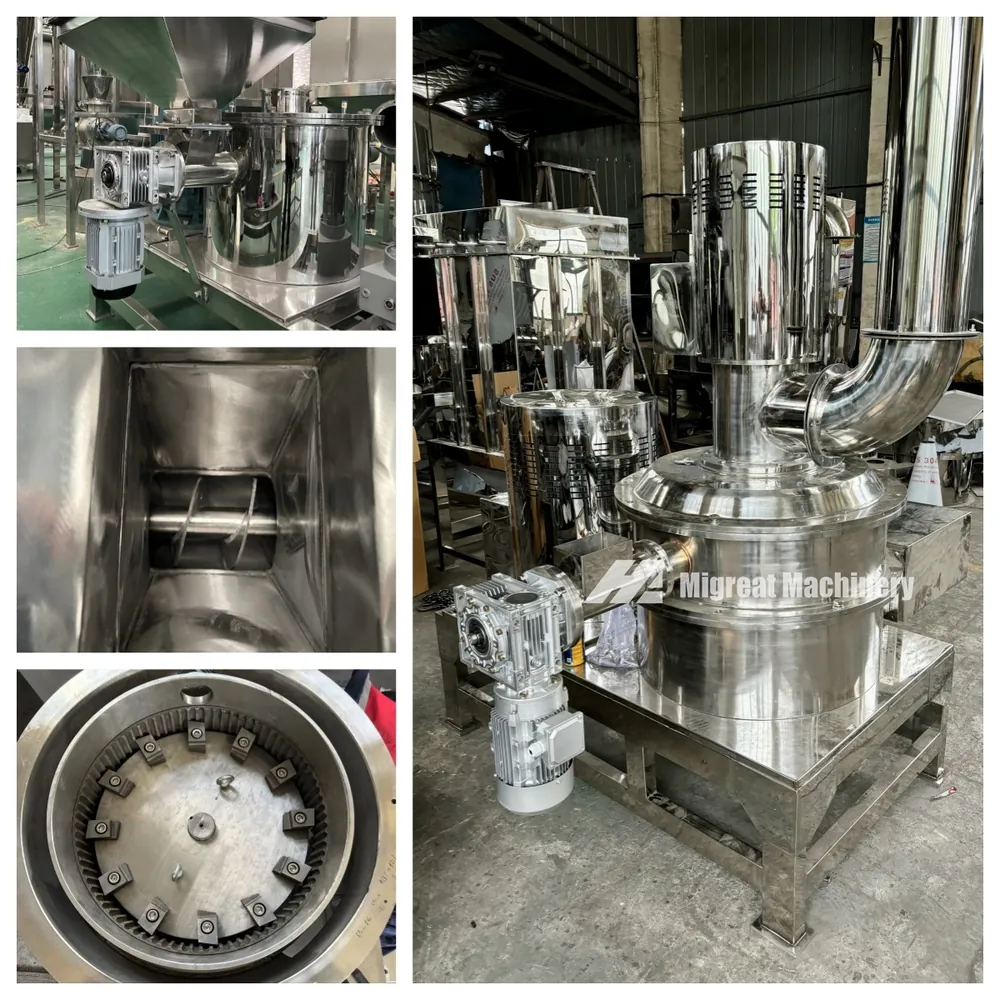
An air classifier mill diagram has six items on the main path. The feeder, the grinding chamber with its blades, the grading wheel, the cyclone, the pulse dust collector and the fan. The WFJ page adds the electric control box and splits the plant into a main machine and an auxiliary machine. The photographs show a line with the cyclone, collector and fan, and the machine from the front.
What the grading wheel does in the air classifier mill principle
The grading wheel sorts particles by the balance of two forces. Air drag pulls a particle in toward the wheel, and centrifugal force from the spinning wheel throws it back out. Small particles are light enough for the air to win and they pass through. Large particles are heavy enough for centrifugal force to win and they are rejected.
Because centrifugal force grows with the square of the wheel speed, a faster wheel pushes back harder and only smaller particles get through. That is the whole reason the dial works. The WFJ page states it plainly, saying the grading motor speed sets the fineness and that the faster it turns the finer the powder.
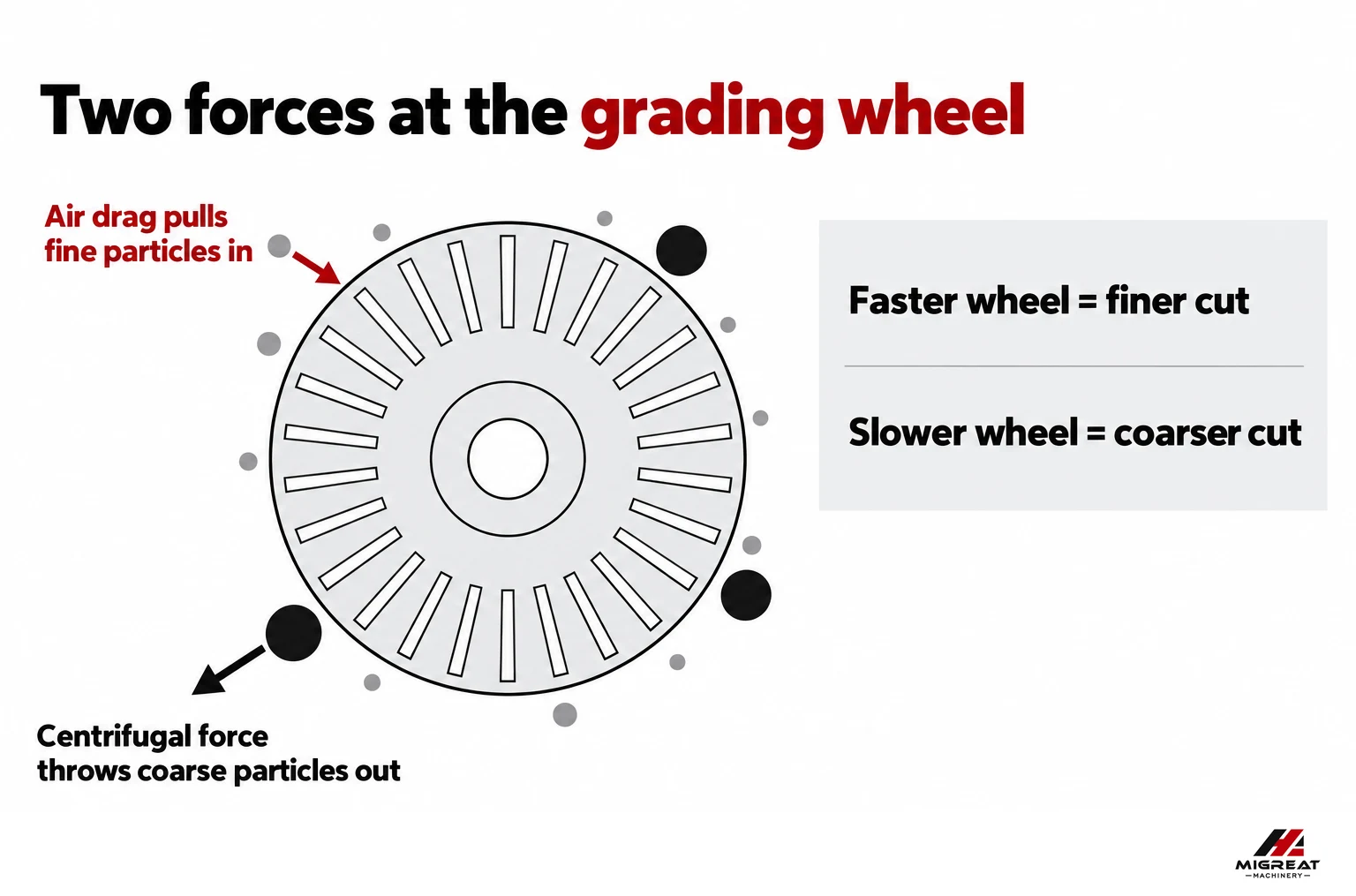
Two practical points follow from this. The cut is not sharp, and a few coarse particles can slip through and a few fine ones can be rejected. And the cut depends on the air flow as well as the wheel speed, because the drag on a particle depends on how much air is moving. A change in the fan or a dirty filter in the collector shifts the result, which is one reason the pulse cleaning of the collector matters for fineness and not only for dust.
Why there is no screen to clog
A screen decides the size by hole diameter, and any material that smears or sticks will fill the holes. Oily spice, sugar and fibrous roots do exactly that. The WFJ avoids the problem because the size is decided by the wheel and the air, and neither has a hole to block. The page says oily, sugary and fibrous material does not clog the machine.
The same page makes a second claim that matters for buyers of herbs. Roots, stems and leaves are the kind of material a regular grinder only reduces to about 60 mesh, because the fibers bend and block screens. A classifier mill cuts them with blades and releases them through the wheel, so the limit becomes the wheel setting and not the screen.
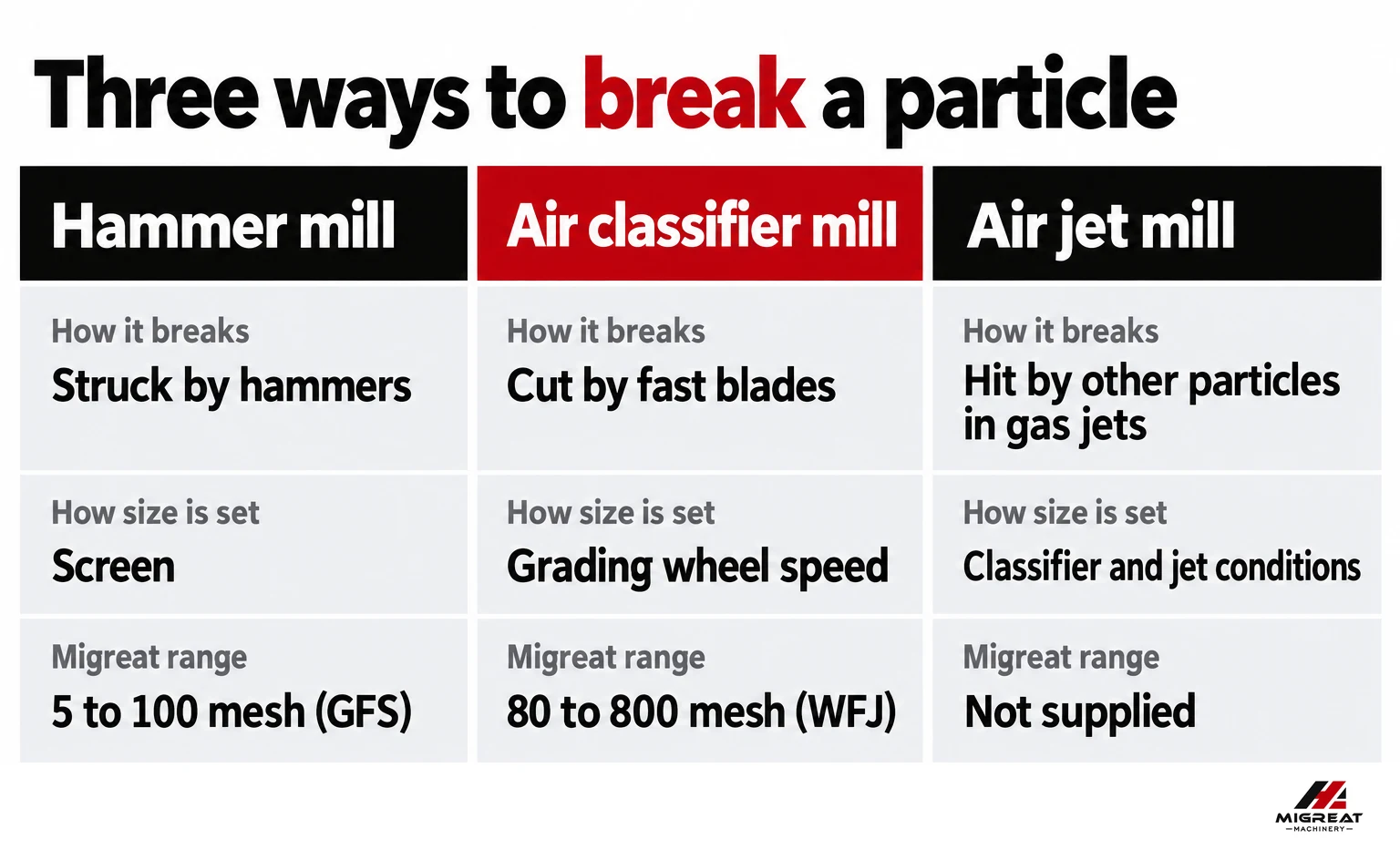
The trade is cost. A screened hammer mill is simpler, cheaper to run and easy to understand. If the product is dry and brittle and 100 mesh is fine, the hammer mill is the better answer, and the hammer mill working principle page explains how it holds that size. The classifier mill earns its place when the target is above about 120 mesh, when the spread of sizes must be narrow, or when the material would blind a screen.
Air classifier mill or air jet mill
An air classifier mill is not an air jet mill. The WFJ page says so directly. It cuts material with fast turning blades and sorts the powder with air and a grading wheel. A jet mill has no blades. It drives particles into each other with jets of compressed air or gas, and it is used for very fine and very pure powders where contact with moving parts has to be avoided.
If you came here because a search sent you to air jet milling, the practical advice is the same as for any machine. Say the material, the size you need and the capacity, and ask which principle the supplier would use and why.
Reading the WFJ model table
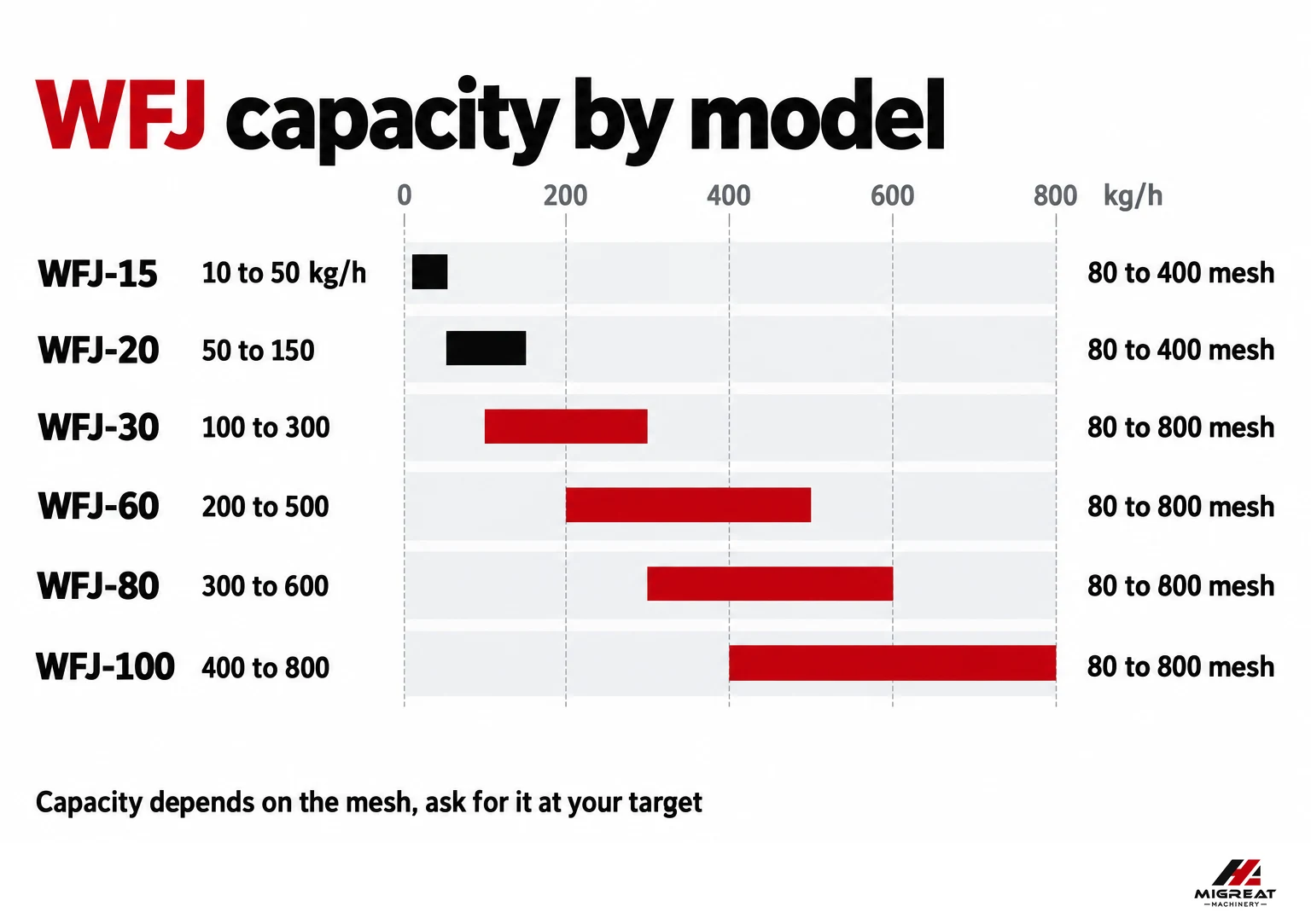
The table lists six sizes. Capacity rises from 10 to 50 kg/h on the WFJ-15 to 400 to 800 kg/h on the WFJ-100. Total motor power runs from 14 to 124 kW, the main shaft slows from 4,000 to 2,000 rpm, and the footprint grows from 5.5 meters long to 10 meters. The two smallest models stop at 400 mesh and the four larger ones reach 800.
Two things are worth noticing. The feed size limit is small, 6 to 20 mm, and material that comes in as whole pods or large pieces needs a crusher first. The PSJ coarse crusher takes pieces down to 0.5 to 20 mm, and the particle size reduction page explains how to chain the stages. And the wide capacity range on each row is not a promise at every fineness. The page says sizes are for reference, so the capacity at 300 mesh needs to be confirmed for your material.
Why finer powder means lower capacity
Finer powder takes more passes. Every particle that is rejected by the wheel goes back to the grinding zone, and the finer the cut, the larger the share of the material that circulates and the more energy each kilogram of product uses. That is general behavior for any classifier mill and it is why the capacity range on each model is wide.
The model tables give a way to see the pattern. Divide the total motor power by the rated capacity and the WFJ-100 comes to about 0.16 to 0.31 kWh per kilogram, while the small WFJ-15 comes to 0.28 to 1.4. These are calculated from rated values and are a guide and not a measurement. They are also the reason the sizing rule is to run a machine inside its range and not at either end.
Heat, cooling and dust control
Fine grinding makes heat, and the finer the grind the more of it. The WFJ has a water cooled jacket around the grinding chamber and bearings, and an air cooler can be fitted instead for heat sensitive material. Oily spice and sugar are the materials where this matters most, and the low temperature grinding page explains the cold air option for spices.
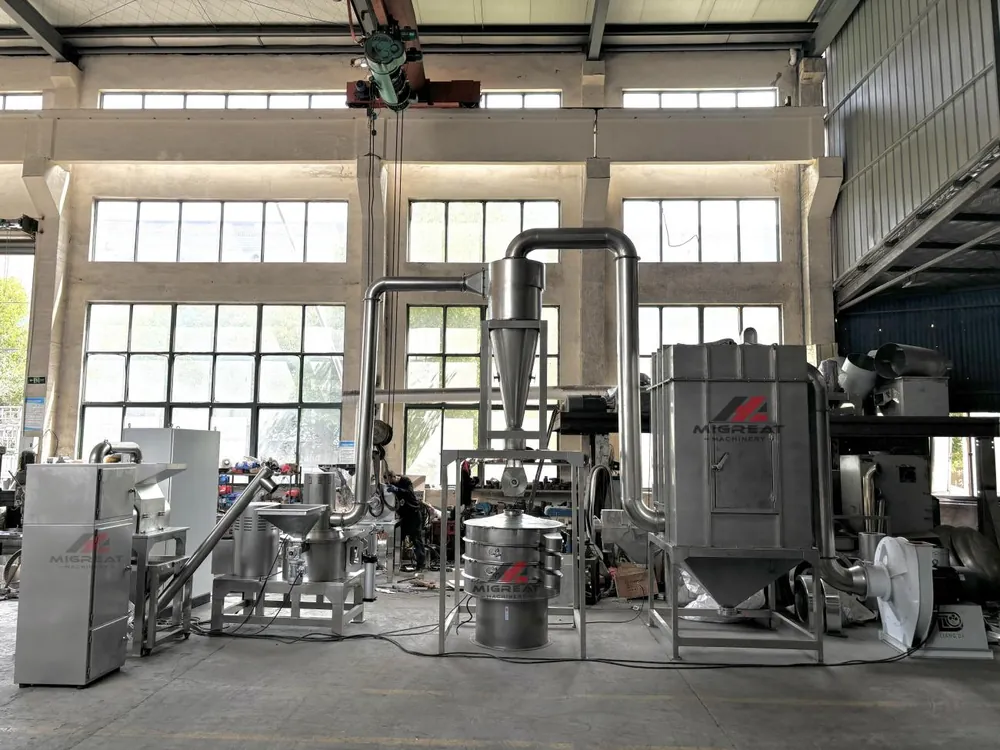
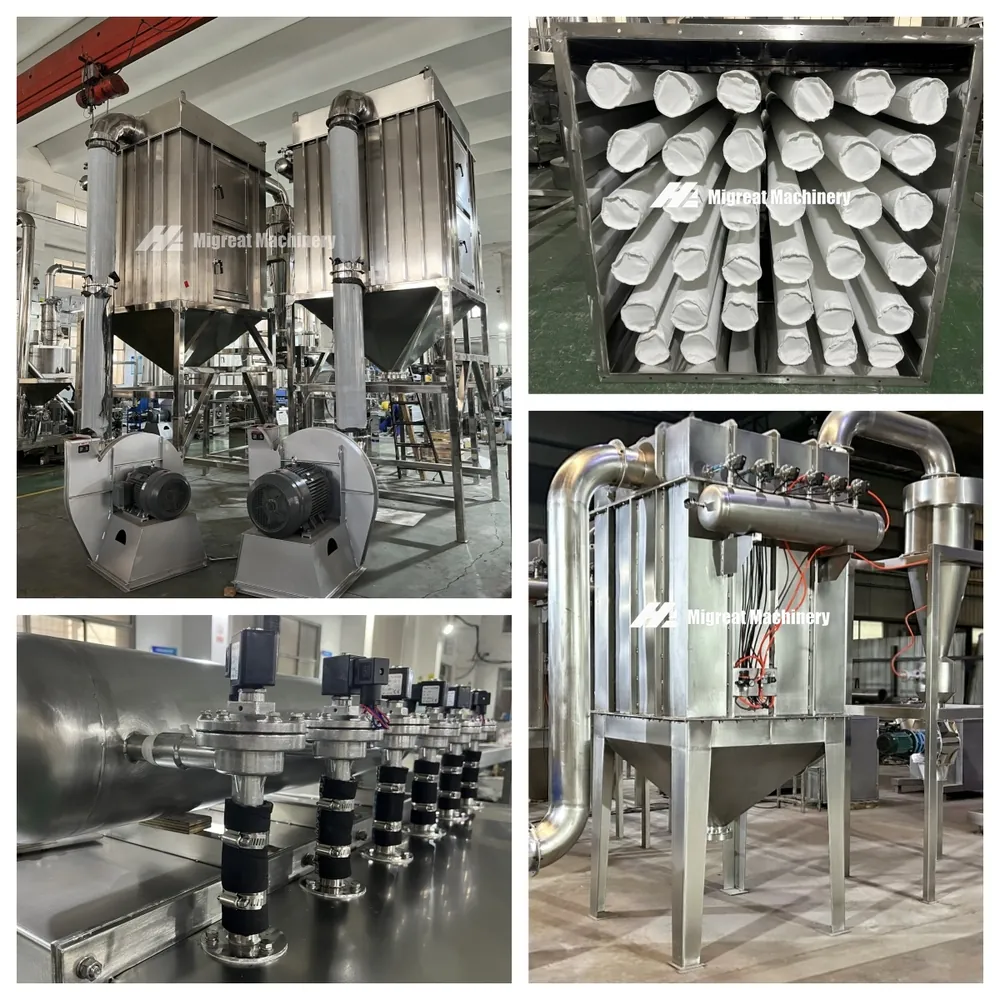
Dust stays in the system. The collector is a pulse type, the dust is held in the collection box, and the page states that the design meets GMP production standards. Ask your supplier what that statement covers for your product, because the standard that applies depends on the industry and the country.
A worked example, cinnamon at 300 mesh
Take a plant that wants cinnamon at 300 mesh and 150 kg/h. Three numbers decide the machine. The feed must be 10 mm or smaller for the WFJ-20 and 12 mm or smaller for the WFJ-30, and quills or bark need to go through a crusher first. The mesh is 300, which is beyond what any screened mill on our pages is sold for, and that makes the classifier route the right one. And the capacity must be checked at the fineness, not at the top of the rated range.
The WFJ-20 lists 50 to 150 kg/h and reaches 400 mesh, and 150 kg/h at 300 mesh would sit at the very top of its range where the fine cut is hardest to hold. The WFJ-30 lists 100 to 300 kg/h and reaches 800 mesh, and 150 kg/h sits in the lower half with room for the wheel to run fast. On paper the WFJ-30 is the safer choice, and the trial grind on your own cinnamon will confirm it.
The check after the mill is a sieve. A 300 mesh opening is close to 48 microns, between the 270 mesh and 325 mesh sizes, and the mesh to micron chart explains why such a size is usually confirmed by laser size analysis and not only by a screen.
What the mill grinds, and what it does not suit
The WFJ page lists the materials it handles in three groups. Food and spice material such as sugar, turmeric, pepper, ginger and salt. Herbal material such as moringa leaf, roots, stems and leaves. And other industries, with chemical products, medicines, cosmetics, plastic, dyestuff, resin and grain named. The common thread is a dry feed that can be cut by blades and carried by air.
It is worth saying what the principle does not do. A classifier mill needs a feed that flows and an air stream that can carry the powder, so very damp, sticky or low melting material can coat the wheel and the cyclone. If the feed is damp, dry it first, as the particle size reduction page explains. Material that softens with heat needs the cooling option, and for some of it the cold air route is a better answer than any amount of jacket cooling.
Hard, abrasive material is a different question. Blades and wheel wear faster on abrasive feeds, and wear changes the cut over time. The page says nothing about wear life, so ask for it in writing with the material named. For abrasive minerals a different machine may fit better, and an honest supplier will say so.
When to move from a hammer mill to a classifier mill
The decision comes down to four questions asked in order. The first is the target mesh. Up to about 100 mesh a screened mill does the job and the air classifier mill working principle adds cost without adding value. Above about 120 mesh the screened mills on our pages stop and the classifier route starts.
- Is the target finer than about 120 mesh? If yes, a classifier mill is the realistic route.
- Does the material smear, stick or contain fiber that blocks screens? If yes, the screenless wheel helps even at a coarser target.
- Does the product need a narrow spread of sizes? If yes, the wheel narrows the top of the distribution better than a screen.
- Is the capacity above what a single classifier line gives at your mesh? If yes, plan two lines or a hammer mill stage before the classifier mill.
Many plants use both in sequence. A hammer mill or universal grinder takes the material to a medium size, and the classifier mill finishes it. The first stage handles most of the size reduction at low energy, and the second stage works on a feed that is already small. The grinding machines page shows the full range for each stage.
What installation involves
The WFJ air classifier mill ships as a main machine, an auxiliary machine and an electric control box. The page says that on delivery you connect 4 pipes and 5 motor power lines, then run it. The footprint is the larger constraint. The table puts the plant at 5.5 by 1.0 by 2.0 meters for the smallest model and 10 by 2.0 by 4.5 meters for the largest, so check the room height and the path for the cyclone and collector before ordering.
Plan the layout around the whole line. A coarse crusher and a screw conveyor sit ahead of the mill, and a vibrating sifter and packing sit behind it. The spice grinding line page walks through that order.
Mistakes buyers make with classifier mills
- Choosing a classifier mill for a 60 mesh job that a hammer mill does for a fraction of the power.
- Reading the capacity at the top of the range as the capacity at the target mesh.
- Feeding oversize pieces because the feed size limit was not checked.
- Judging fineness by feel and not by a sieve or a laser test, with the test method agreed beforehand.
- Forgetting that the collector and fan are part of the fineness, and skipping their upkeep.
Questions to put in the quotation
A quotation that lists a model and a price leaves out the facts that decide whether the mill holds your number. Ask for these in writing.
- The capacity at your target mesh on your material, not the rated range.
- The wheel speed range and the largest feed size.
- The cooling option and the product temperature expected.
- The test used to confirm fineness, the standard of the screen or the method of the laser test.
- A trial grind on a sample of your material before the order, if the supplier offers one.
Air classifier mills at work
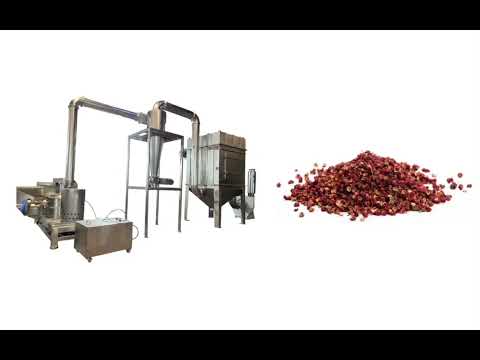
The videos show the WFJ grinding cinnamon, chili and a mixed spice and salt batch. The titles name the mesh in each run.


The air classifier mill working principle comes down to this. The wheel sets the size, the air carries the powder, and the capacity you are quoted has to be the capacity at your mesh.
Send the material, the target mesh with the share passing and the capacity per hour through the contact page, and an engineer can name the WFJ model that fits. The grinding machines page lists every mill, and the hammer, pin and air classifier mill comparison sets the three side by side.
Air classifier mill FAQ
QWhat is the air classifier mill working principle?
Fast turning blades cut the material in a grinding chamber, and an air stream carries the powder to a rotating grading wheel. Only particles fine enough to pass the wheel leave with the air, and coarse particles stay for another pass. The wheel speed sets the fineness.
QWhat is air classification?
Air classification sorts powder by size with an air stream and a rotating wheel. Air drag pulls small particles through the wheel and centrifugal force throws large particles back. In the WFJ mill the grading motor speed sets the cut from 80 to 800 mesh, so no screen is needed.
QHow does an air classifier mill work?
Air carries the powder toward the wheel. Small particles follow the air through the gaps, and large particles are thrown back into the grinding zone by centrifugal force. A faster wheel gives a finer cut. A cyclone and pulse dust collector then separate the powder from the air.
QHow does an air jet mill work, and is it the same?
No. A jet mill has no blades and drives particles into each other with jets of compressed air or gas. The WFJ is an air classifier mill that cuts with fast turning blades and sorts with a grading wheel. Migreat does not supply jet mills.
QWhat fineness can an air classifier mill reach?
The WFJ series states 80 to 800 mesh. The two smallest models, WFJ-15 and WFJ-20, stop at 400 mesh and the larger four reach 800. Capacity falls as the powder gets finer, so ask for the capacity at your target mesh.
QWhy does an air classifier mill not clog on oily material?
There is no screen. The size is decided by the grading wheel and the air, and neither has a hole to block. The WFJ page states that oily, sugary and fibrous material does not clog the machine.
QWhen should I use a hammer mill instead?
When the product is dry and brittle and 100 mesh is enough. A screened hammer mill is simpler and cheaper to run. Move to a classifier mill when the target is above about 120 mesh, when the spread of sizes must be narrow, or when the material would blind a screen.