 +86 139 1520 0887
 info@migreatmachinery.com
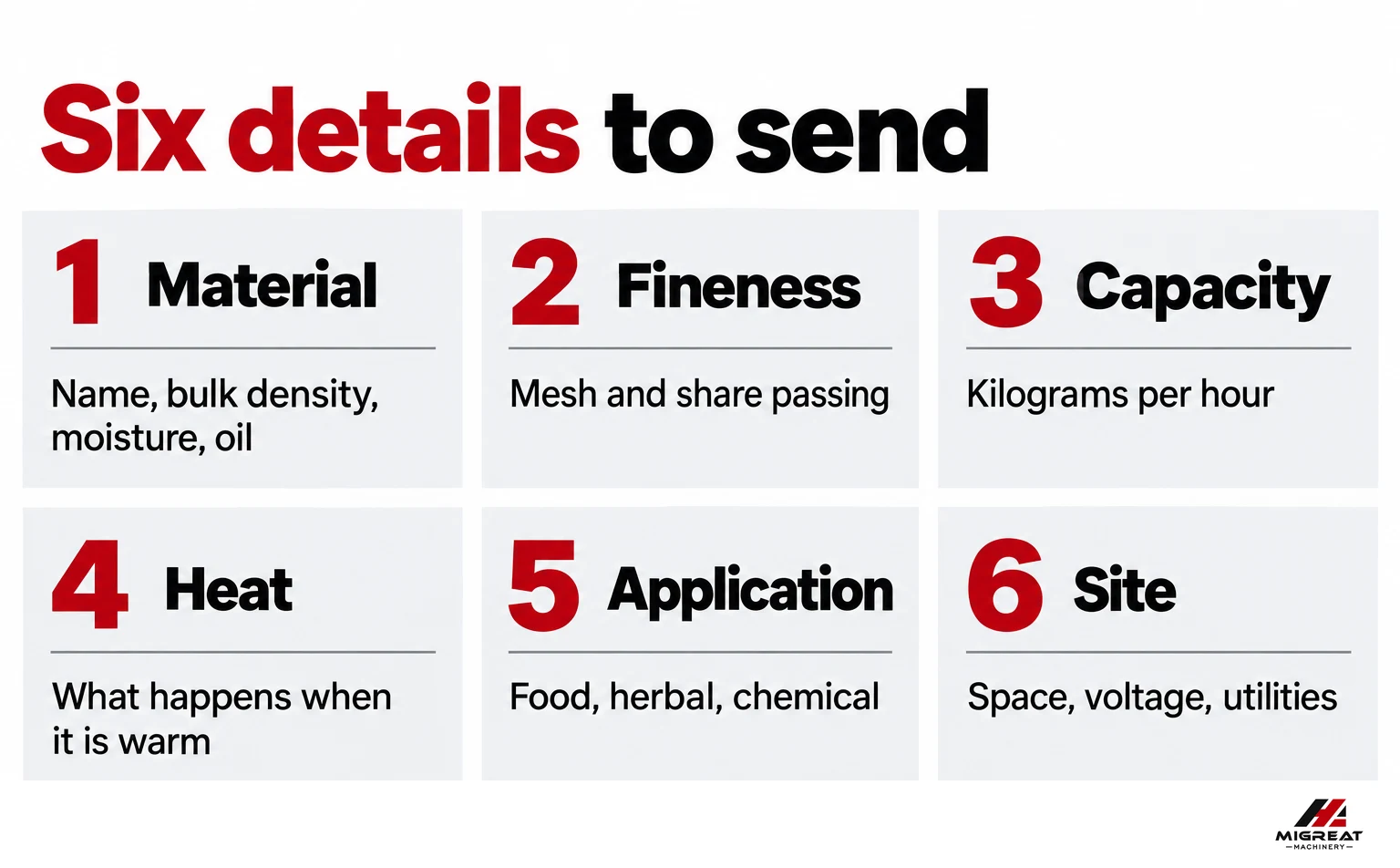
What to send before a quote comes down to six facts. The material with its name, bulk density, moisture and oil content. The target fineness or granule. The capacity per hour. The heat sensitivity. The application. And the site, with space, voltage and any other limits. With those an engineer can reply with a suitable machine in the first message, instead of asking follow-up questions first.
You do not need exact numbers. Approximate capacity and fineness are enough to start, and a photo or a short description of the material helps if there is no datasheet. Send the details through the contact form, by email to info@migreatmachinery.com or by phone, and an engineer checks your material and requirements against our machines.
- The material, with name, bulk density, moisture and oil content
- Target fineness and capacity per hour
- Heat sensitivity and application
- Site conditions such as space and voltage
What information do I need for a quote is the question behind most enquiries, and the answers are short. Most enquiries for a powder machine arrive with one line, usually a machine name and the word price. We can answer that line, and the answer is a question. What is the material, how fine, how much per hour. Sending those answers first saves a day or two on each side and gets a better recommendation.
This page explains what to send before a quote for a powder machine or a line, why each fact matters, how to find the numbers if you have no datasheet, and what happens after you send them. It also gives a short list for each machine type and a sample message you can copy. It does not cover price negotiation or contract terms, which come after the machine is chosen.
What to send before a quote, the six details that matter
An engineer needs six facts to recommend a machine. The table lists each one and why we ask. Together they decide the machine type, the size and the options, and any one of them missing leaves a gap that has to be filled by a guess or a question.
Describe the material, not only its name
Two powders with the same name can behave very differently. Dried chili with a low moisture grinds cleanly, and the same chili at 12 percent moisture smears. Say the name, then the facts that change its behavior. The bulk density, in kilograms per liter, because machine volume is quoted in liters and capacity in kilograms. The moisture, in percent. The oil content, in percent. And whether it is fibrous, sticky, abrasive, dusty or hard.
Add the form it arrives in. Whole pods, chopped pieces, granules, powder or a wet cake need different first stages. The largest piece matters, because every mill has a feed size limit, from 6 mm on the smallest WFJ to 150 mm on the larger PSJ crushers. If you can, send a photo of the material next to a ruler.
If you have no datasheet, five quick checks
A datasheet is not needed. A few simple checks give numbers good enough to start.
- Bulk density. Fill a 1 liter container with the powder without pressing it down, level the top and weigh it. The weight in kilograms is the bulk density.
- Moisture. Use a moisture meter if you have one, or ask the supplier of the material for the figure. A rough answer such as about 8 percent is fine.
- Largest piece. Measure the biggest piece or the typical size with a ruler.
- Oil and stickiness. Rub the powder between your fingers. If it smears or clumps, say so.
- Target size. If you do not know the mesh, send a sample of the powder you want, or a competitor's product, and an engineer can match it.
The mesh to micron chart turns a mesh into a size if you want to check the number you were given.
State the fineness so it can be checked
A fineness is only useful if it can be tested. Say the mesh and the share that must pass it, for example at least 95 percent through 100 mesh. Say how it will be checked, usually a sieve test on a US series screen. A bare mesh number leaves room for two readings, and a dispute later.
If the powder will be used in a particular way, say that too. A powder that must dissolve fast, flow through a filler or give a smooth feel on the tongue may need a second limit, such as a share through a finer screen. An engineer can suggest it, and it costs nothing to ask.
Capacity, in the units that matter
Give the capacity in kilograms per hour of finished product. If your plan is in tons a year, say how many hours a day and days a year the line runs, and an engineer can convert. For batch machines give the batch weight and the number of batches per shift. For dryers, give the water to be removed per hour if you know it, or the feed rate and the moisture before and after.
Approximate figures are enough. A line sized for 150 kg/h and one for 500 kg/h are different projects, and knowing which one you are planning matters more than whether it is 150 or 170. If the plan may grow, say so, and the layout can leave room.
Heat sensitivity and application
Say how much heat the material tolerates. A spice that loses aroma above a certain temperature needs cooling, a dryer feed that scorches needs a lower inlet temperature, and a pharmaceutical powder may need a closed system. If you do not know the limit, say what happens when it is heated, such as it darkens, smells or gets sticky.
The application tells us the hygiene level and the finish. Food, herbal, nutraceutical, chemical and building powders have different needs for stainless steel, surface finish, cleaning and records. Say whether the product is for food contact, for a regulated market or for industrial use, and whether any certificate is required.
Site conditions
The room and the utilities shape the machine. Send the length, width and height available, the voltage and frequency of the power supply, and whether steam, compressed air, cooling water or gas is on site. Say if there are limits on noise, dust or floor loading, and if the machine must pass through a door of a given width.
If you are planning a line, a rough sketch of the room with the doors and the position of the utilities is worth more than a page of text. A phone photo of the room and a tape measure reading is enough to start.
What to send for each machine type
The six facts apply to every machine, and each type adds a few. The table lists them.
A good request and a poor one
The difference between a good and a poor request is plain once you see them next to each other. The table compares what an engineer can do with each.
The third request takes five minutes to write, and it saves the engineer and you the time of two rounds of questions. It also gives a better answer, because the engineer works from facts and not from a guess at what a typical customer wants.
Sending a sample for a trial
If a trial is part of the choice, send a sample that represents the material. Take it from several places in a batch and mix it, because a handful from the top of a sack may not match the rest. Pack it dry in a sealed bag inside a strong box, label it with the name, the date and the batch, and note the moisture and storage. A few kilograms are usually enough for a small machine, and more may be needed for a mill that has to reach steady running.
Tell us what you want to learn from the trial. The sieve result at your mesh, the powder temperature, the rate, the color, or all of them. Agree how the result will be reported, with the settings used, so that you can compare it with the quotation. Keep a retained sample of the same batch, and compare it with what the trial produces.
What to expect on timing
A clear request gets a clear reply, usually within a short working time, and an unclear one gets questions. The recommendation is the first step. A quotation with prices, options and lead time follows once the machine is chosen, and a trial adds the time of shipping the sample and running the test. Ask for the steps and the expected time for each at the start, so that your own project plan has dates.
If your project has a deadline, say so in the first message, and say what it is tied to, a plant opening, a season or a customer order. It changes what an engineer recommends, because a standard machine can be delivered faster than a custom one, and a smaller first phase may meet the date when the full line cannot.
What happens after you send it
Send the details
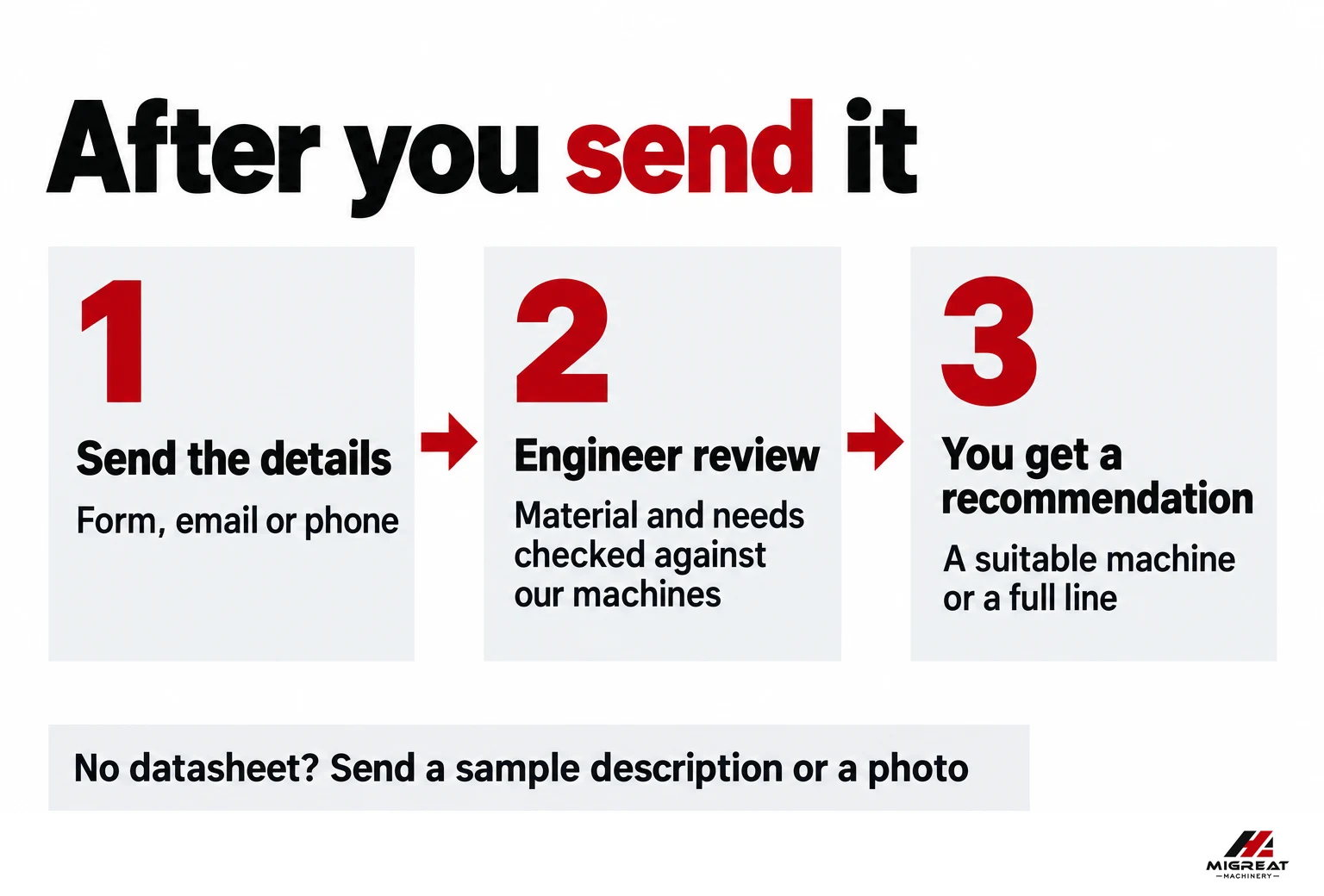
Use the form on our site, email info@migreatmachinery.com or call +86 139 1520 0887. Send what you have and note what you do not know.
Engineer review
An engineer checks your material and requirements against our machines and may ask a question or two if something decides the choice.
You get a recommendation
A suitable machine, or a full line, for your powder, with the reasons and the figures it rests on.
If the choice is close, ask for a trial on your own material and send a sample. A trial answers questions that no table can, and the result goes into the quotation. Ask what the trial will measure, and ask for the numbers in writing.
How to ask for a quote, a sample message to copy
A quote request is best when it is short and specific. The version below covers the six facts in a few lines, and you can change the numbers.
We want to grind dried ginger, in pieces up to 30 mm, bulk density about 0.35, moisture about 10 percent, slightly fibrous. Target 60 mesh with at least 95 percent passing, 200 kg per hour, for food use. The ginger darkens if it gets hot. Our room is 12 by 6 meters, 4 meters high, 380 V three phase, compressed air available.
That message tells an engineer the material, the feed size, the target, the capacity, the heat issue, the application and the site. The reply can name a crusher and a mill, a cooling option and a sifter, and say what to test. The same enquiry without those details would need three rounds of questions.
What to ask in return, and what to send before a quote that you would want back
A quotation is a two way exchange. Ask us the questions that decide whether the machine works for you.
- What capacity will the machine give at my fineness on my material, not at the top of the range?
- What did you assume about the bulk density, moisture and feed size?
- Which options are in the price and which are extras?
- Can you run a trial on my sample, and what will you measure?
- What are the lead time, the installation support and the spare parts list?
Mistakes to avoid
- Sending only a machine name and the word price.
- Giving a mesh number without the share that must pass it.
- Quoting a capacity in tons a year with no operating hours.
- Leaving out the oil, stickiness or moisture of the material.
- Skipping the site facts, then finding that the machine does not fit the room.
Where your machine is built
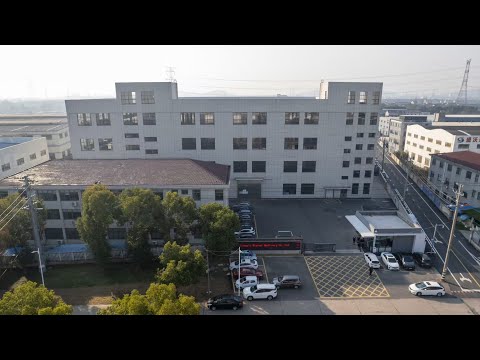
The factory video shows the workshop of Jiangyin Migreat Machinery where the machines are designed and built.
No datasheet yet? Send what you know. A sample description or a photo of the material is a good start.
Send your details through the contact page, and an engineer will reply with a recommendation. Browse the WFJ air classifier mill, the WLDH ribbon mixer and the grinding machines page to see the range, and read the powder processing line page if you are planning a whole line.
Quote request FAQ
QWhat to send before a quote, and what information do I need?
Send the material with its name, bulk density, moisture and oil content, the target fineness and capacity per hour, the heat sensitivity and application, and the site conditions such as space and voltage. Approximate figures are enough to start.
QHow do I ask a supplier for a quote?
Use the form on our site, email info@migreatmachinery.com or call +86 139 1520 0887. An engineer checks your material and requirements against our machines and replies with a recommendation, asking a question or two if something decides the choice.
QHow to professionally ask for a quote?
Give the details that decide the machine up front. Material behavior sets the machine type, target fineness sets the mill and screen, and capacity per hour sets the size and the rest of the line. A sample description or a photo helps if you have no datasheet.
QDo I need exact numbers?
No. Approximate capacity and fineness are enough to start. A line for 150 kg/h and one for 500 kg/h are different projects, so knowing which one matters more than the last digit. State what you do not know, and an engineer can suggest how to find it.
QHow do I measure bulk density?
Fill a 1 liter container with the powder without pressing it down, level the top and weigh it. The weight in kilograms is the bulk density in kilograms per liter. It lets us convert machine volume in liters to capacity in kilograms.
QCan you test my material before I order?
Ask for a trial on a sample of your material and agree what will be measured, such as sieve result, powder temperature and rate. The result goes into the quotation. A short test costs far less than a machine that cannot hold the number.